
India election results: Modi claims victory for alliance
Bharatiya Janata Party (BJP) supporters listen to prime minister Narendra Modi’s victory speech at the party headquarters in New Delhi.
Today’s live coverage has ended, but there’s still plenty to catch up on. Read what you missed below and find more coverage on the AP’s global elections hub.
India’s Prime Minister Narendra Modi has claimed victory for his alliance as early results from the staggered, six-week election showed fewer seats for his Bharatiya Janata Party than expected and it appeared unlikely to secure a majority on its own. Final figures are not expected until Wednesday local time, with counting going late into the night.
Here’s what to know:
- Where results stand: After winning a record 303 seats in 2019, Modi’s Bharatiya Janata Party appeared unlikely to win more than 240, far short of the 272 needed to form a majority government on its own.
- National Democratic Alliance: The political coalition led by Modi’s party appears on track to win a combined 286 seat majority.
- Modi claims early victory: In a speech to supporters, Modi claimed victory for his alliance, calling the election a big win despite the stronger-than-expected challenge from the opposition.
PHOTOS: Parties and supporters in celebratory mode
Across India, supporters of various political parties, leaders and candidates celebrated wins as counting nears its end
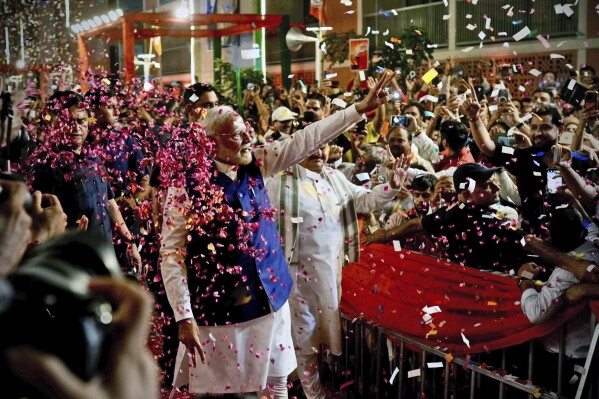
Prime Minister Narendra Modi is greeted by supporters as he arrives at Bharatiya Janata Party (BJP) headquarters in New Delhi, India, Tuesday, June 4, 2024. (AP Photo/Manish Swarup)

A supporter of Shiv Sena (Uddhav Balasaheb Thackeray) dances as he celebrates with others their party’s lead during the counting of votes in India’s national election in Mumbai, India, Tuesday, June 4, 2024. (AP Photo/Rafiq Maqbool)

Samajwadi Party supporters celebrate their party’s lead during the counting of votes in India’s national election in Lucknow, India, Tuesday, June 4, 2024. (AP Photo/Rajesh Kumar Singh)

Congress Party leader Rahul Gandhi, in white shirt, sees his mother and party leader Sonia Gandhi off as she leaves the party headquarters after feeling physical discomfort during a press conference in New Delhi, India, Tuesday, June 4, 2024. (AP Photo/Altaf Qadri)

Congress Party supporters wait to get a glimpse of the party leader Rahul Gandhi at the party headquarters in New Delhi, India, Tuesday, June 4, 2024. (AP Photo/Altaf Qadri)

Dravida Munnetra Kazhagam (DMK) party supporters celebrate as they follow proceedings of the vote counting at their party headquarters in Chennai, India, Tuesday, June 4, 2024. (AP Photo/Mahesh Kumar A.)

Trinamool Congress Party leader and Chief Minister of West Bengal state, Mamata Banerjee, and her nephew and party leader Abhishek Banerjee make a victory sign with their hands as they arrive to address a press conference in Kolkata, India, Tuesday, June 4, 2024. (AP Photo/Bikas Das)

Bharatiya Janata Party (BJP) supporters dance inside the party office after hearing of a candidate’s victory during the counting in India’s national election, in New Delhi, India, Tuesday, June 4, 2024. Prime Minister Narendra Modi’s Hindu nationalist party showed a comfortable lead Tuesday, according to early figures reported by India’s Election Commission, but was facing a stronger challenge from the opposition than had been expected. (AP Photo/Manish Swarup)

Supporters of Congress Party cheer the party leader Rahul Gandhi, center, as he leaves the party headquarters after addressing a press conference in New Delhi, India, Tuesday, June 4, 2024. (AP Photo/Altaf Qadri)

A Congress Party supporter carries a flag printed with a portrait of party leader Rahul Gandhi at the party headquarters in New Delhi, India, Tuesday, June 4, 2024. (AP Photo/Altaf Qadri)

A Samajwadi Party supporter carries portraits of party leader Akhilesh Yadav, right, and Congress Party leader, Rahul Gandhi, as he celebrates his party’s lead during the counting of votes in India’s national election in Lucknow, India, Tuesday, June 4, 2024. (AP Photo/Rajesh Kumar Singh)

Workers carry a large cutout portrait of Indian Prime Minister Narendra Modi at the party headquarters in New Delhi, India, Tuesday, June 4, 2024. (AP Photo/Manish Swarup)
Prime Minister Narendra Modi is greeted by supporters as he arrives at Bharatiya Janata Party (BJP) headquarters in New Delhi, India, Tuesday, June 4, 2024. (AP Photo/Manish Swarup)
Prime Minister Narendra Modi is greeted by supporters as he arrives at Bharatiya Janata Party (BJP) headquarters in New Delhi, India, Tuesday, June 4, 2024. (AP Photo/Manish Swarup)
A supporter of Shiv Sena (Uddhav Balasaheb Thackeray) dances as he celebrates with others their party’s lead during the counting of votes in India’s national election in Mumbai, India, Tuesday, June 4, 2024. (AP Photo/Rafiq Maqbool)
A supporter of Shiv Sena (Uddhav Balasaheb Thackeray) dances as he celebrates with others their party’s lead during the counting of votes in India’s national election in Mumbai, India, Tuesday, June 4, 2024. (AP Photo/Rafiq Maqbool)
Samajwadi Party supporters celebrate their party’s lead during the counting of votes in India’s national election in Lucknow, India, Tuesday, June 4, 2024. (AP Photo/Rajesh Kumar Singh)
Samajwadi Party supporters celebrate their party’s lead during the counting of votes in India’s national election in Lucknow, India, Tuesday, June 4, 2024. (AP Photo/Rajesh Kumar Singh)
Congress Party leader Rahul Gandhi, in white shirt, sees his mother and party leader Sonia Gandhi off as she leaves the party headquarters after feeling physical discomfort during a press conference in New Delhi, India, Tuesday, June 4, 2024. (AP Photo/Altaf Qadri)
Congress Party leader Rahul Gandhi, in white shirt, sees his mother and party leader Sonia Gandhi off as she leaves the party headquarters after feeling physical discomfort during a press conference in New Delhi, India, Tuesday, June 4, 2024. (AP Photo/Altaf Qadri)
Congress Party supporters wait to get a glimpse of the party leader Rahul Gandhi at the party headquarters in New Delhi, India, Tuesday, June 4, 2024. (AP Photo/Altaf Qadri)
Congress Party supporters wait to get a glimpse of the party leader Rahul Gandhi at the party headquarters in New Delhi, India, Tuesday, June 4, 2024. (AP Photo/Altaf Qadri)
Dravida Munnetra Kazhagam (DMK) party supporters celebrate as they follow proceedings of the vote counting at their party headquarters in Chennai, India, Tuesday, June 4, 2024. (AP Photo/Mahesh Kumar A.)
Dravida Munnetra Kazhagam (DMK) party supporters celebrate as they follow proceedings of the vote counting at their party headquarters in Chennai, India, Tuesday, June 4, 2024. (AP Photo/Mahesh Kumar A.)
Trinamool Congress Party leader and Chief Minister of West Bengal state, Mamata Banerjee, and her nephew and party leader Abhishek Banerjee make a victory sign with their hands as they arrive to address a press conference in Kolkata, India, Tuesday, June 4, 2024. (AP Photo/Bikas Das)
Trinamool Congress Party leader and Chief Minister of West Bengal state, Mamata Banerjee, and her nephew and party leader Abhishek Banerjee make a victory sign with their hands as they arrive to address a press conference in Kolkata, India, Tuesday, June 4, 2024. (AP Photo/Bikas Das)
Bharatiya Janata Party (BJP) supporters dance inside the party office after hearing of a candidate’s victory during the counting in India’s national election, in New Delhi, India, Tuesday, June 4, 2024. Prime Minister Narendra Modi’s Hindu nationalist party showed a comfortable lead Tuesday, according to early figures reported by India’s Election Commission, but was facing a stronger challenge from the opposition than had been expected. (AP Photo/Manish Swarup)
Bharatiya Janata Party (BJP) supporters dance inside the party office after hearing of a candidate’s victory during the counting in India’s national election, in New Delhi, India, Tuesday, June 4, 2024. Prime Minister Narendra Modi’s Hindu nationalist party showed a comfortable lead Tuesday, according to early figures reported by India’s Election Commission, but was facing a stronger challenge from the opposition than had been expected. (AP Photo/Manish Swarup)
Supporters of Congress Party cheer the party leader Rahul Gandhi, center, as he leaves the party headquarters after addressing a press conference in New Delhi, India, Tuesday, June 4, 2024. (AP Photo/Altaf Qadri)
Supporters of Congress Party cheer the party leader Rahul Gandhi, center, as he leaves the party headquarters after addressing a press conference in New Delhi, India, Tuesday, June 4, 2024. (AP Photo/Altaf Qadri)
A Congress Party supporter carries a flag printed with a portrait of party leader Rahul Gandhi at the party headquarters in New Delhi, India, Tuesday, June 4, 2024. (AP Photo/Altaf Qadri)
A Congress Party supporter carries a flag printed with a portrait of party leader Rahul Gandhi at the party headquarters in New Delhi, India, Tuesday, June 4, 2024. (AP Photo/Altaf Qadri)
A Samajwadi Party supporter carries portraits of party leader Akhilesh Yadav, right, and Congress Party leader, Rahul Gandhi, as he celebrates his party’s lead during the counting of votes in India’s national election in Lucknow, India, Tuesday, June 4, 2024. (AP Photo/Rajesh Kumar Singh)
A Samajwadi Party supporter carries portraits of party leader Akhilesh Yadav, right, and Congress Party leader, Rahul Gandhi, as he celebrates his party’s lead during the counting of votes in India’s national election in Lucknow, India, Tuesday, June 4, 2024. (AP Photo/Rajesh Kumar Singh)
Workers carry a large cutout portrait of Indian Prime Minister Narendra Modi at the party headquarters in New Delhi, India, Tuesday, June 4, 2024. (AP Photo/Manish Swarup)
Workers carry a large cutout portrait of Indian Prime Minister Narendra Modi at the party headquarters in New Delhi, India, Tuesday, June 4, 2024. (AP Photo/Manish Swarup)
What’s still to come as votes continue to be counted
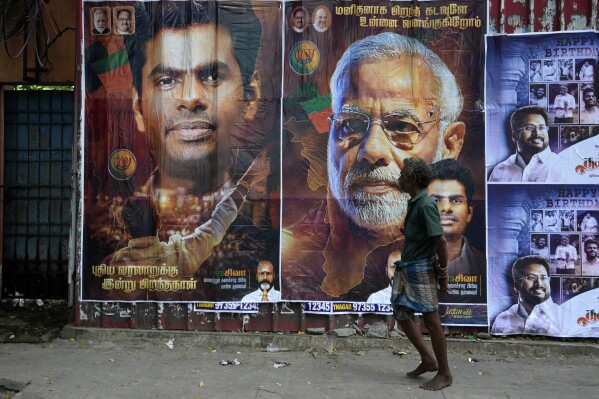
A man walks past posters with portraits of Indian Prime Minister Narendra Modi and Bharatiya Janata Party (BJP) state President K. Annamalai on a street in Chennai, India, Tuesday, June 4, 2024. (AP Photo/Mahesh Kumar A.)
A man walks past posters with portraits of Indian Prime Minister Narendra Modi and Bharatiya Janata Party (BJP) state President K. Annamalai on a street in Chennai, India, Tuesday, June 4, 2024. (AP Photo/Mahesh Kumar A.)
After winning a record 303 seats in 2019, the BJP appeared unlikely to win more than 240, far short of the 272 needed to form a majority government on its own, with 194 seats won and the lead in 46 constituencies and counting ongoing.
Modi’s NDA coalition, meantime, was on track to win a combined 286 seat majority, with 225 seats won and leads in 61 races.
The opposition INDIA coalition appeared as if it would win 210 seats.
Final figures were not expected until Wednesday, with counting going late into the night.
US commends India for demonstrating its ‘vibrant domestic process’
The White House on Tuesday commended India for demonstrating its “vibrant democratic process” after close to 970 million Indians went to the polls during its six-week long election.
White House national security spokesperson John Kirby said the turnout demonstrated the Indian electorate’s commitment to democracy.
“So we celebrate that with them,” Kirby told reporters. ”And we applaud the government writ large for successfully completing a truly, massively-sized electoral undertaking.”
Kirby declined to comment about Prime Minister Narendra Modi and his BJP party’s apparent victory, noting that “not all the votes have been tallied and counted.”
We know who the prime minister will be. What does India’s president do?
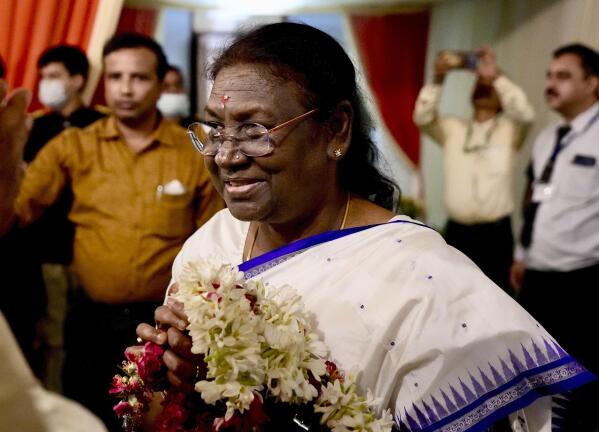
India’s president is its head of state, but the position is largely ceremonial.
Droupadi Murmu, the current president, was elected in 2022 by lawmakers — an electoral college that consists of lawmakers in both houses of Parliament and elected members of the legislative assemblies of all states. She hails from the same political party as Prime Minister Narendra Modi.
The position can be important during times of political uncertainty such as a hung parliament, when the office assumes greater power. The president is bound by the advice of the Cabinet led by the prime minister, who is the chief executive.
14 hours in, here are the tallies
Tallies reported by India’s Election Commission showed Modi’s BJP-led National Democratic Alliance, 209 of them going to BJP.
The opposition Congress party is part of the INDIA alliance, which so far had won 177 seats, 81 of them for Congress.
Tallying is ongoing. A total of 272 seats are needed for a majority.
Learn more about Narendra Modi
Indian Prime Minister Narendra Modi during the inauguration of Kashi Vishwanath Dham Corridor, a promenade that connects the sacred Ganges River with the centuries-old temple dedicated to Lord Shiva in Varanasi, India, Monday, Dec. 13, 2021 (AP Photo/Rajesh Kumar Singh)
Indian Prime Minister Narendra Modi during the inauguration of Kashi Vishwanath Dham Corridor, a promenade that connects the sacred Ganges River with the centuries-old temple dedicated to Lord Shiva in Varanasi, India, Monday, Dec. 13, 2021 (AP Photo/Rajesh Kumar Singh)
India’s Prime Minister Narendra Modi, who claimed victory for his alliance in an election seen as a referendum on his decade in power, is a popular but polarizing leader who has presided over a fast-growing economy while advancing Hindu nationalism.
Modi, 73, is only the second Indian prime minister to win a third straight term.
To supporters, Modi is a larger-than-life figure who has improved India’s standing in the world, helped make its economy the world’s fifth-largest, and streamlined the country’s vast welfare program, which serves around 60% of the population. To some, he may even be more than human.
But to critics, he’s a cult leader who has eroded India’s democracy and advanced divisive politics targeting the Muslims who make up 14% of the country’s population. They say he has also increasingly wielded strong-arm tactics to subdue political opponents, squeeze independent media and quash dissent.
▶ Read more in our profile of the prime minister.
WATCH: Bharatiya Janata Party (BJP) supporters listen to PM Narendra Modi’s victory speech
Bharatiya Janata Party (BJP) supporters listen to prime minister Narendra Modi’s victory speech at the party headquarters in New Delhi.
South Asian neighbors congratulate Modi
As Narendra Modi claimed victory for his alliance, congratulations from neighbors began rolling in on X despite the National Democratic Alliance having several seats to win before securing a majority.
Nepalese Prime Minister Pushpa Kamal Dahal: “Congratulations to PM @narendramodi on the electoral success of BJP and NDA in the Loksabha elections for the third consecutive term. We are happy to note the successful completion of the world’s largest democratic exercise with enthusiastic participation of the people of India.”
Bhutanese Prime Minister Tshering Tobgay: “Congratulations to my friend PM @narendramodi ji and NDA for the historic 3rd consecutive win in the world’s biggest elections. As he continues to lead Bharat to great heights, I look forward to working closely with him to further strengthen the relations between our 2 countries.”
Mauritian Prime Minister Pravind Kumar Jugnauth: “Congratulations Prime Minister Modi Ji @narendramodi on your laudable victory for a historic third term.
Under your helm, the largest democracy will continue to achieve remarkable progress.
Long live the Mauritius-India special relationship.”
Sri Lankan President Ranil Wickremesinghe: I extend my warmest felicitations to the @BJP4India led NDA on its victory, demonstrating the confidence of the Indian people in the progress and prosperity under the leadership of PM @narendramodi. As the closest neighbour Sri Lanka looks forward to further strengthening the partnership with India.”
The length of Modi’s speech claiming victory
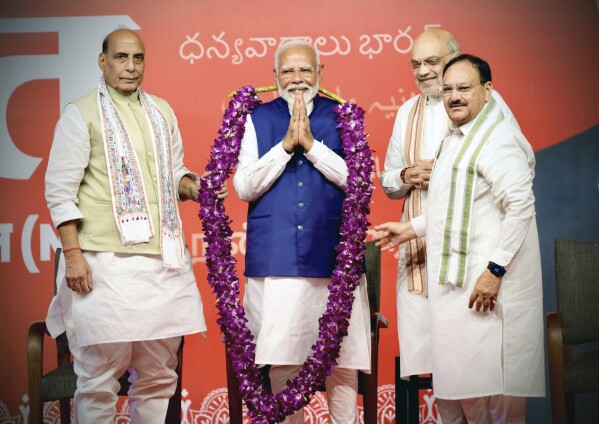
Prime Minister Narendra Modi is garlanded by senior Bharatiya Janata Party (BJP) leaders Rajnath Singh, left, party President JP Nadda, right, and Amit Shah, at the party headquarters in New Delhi, India, Tuesday, June 4, 2024. (AP Photo/Manish Swarup)
Prime Minister Narendra Modi is garlanded by senior Bharatiya Janata Party (BJP) leaders Rajnath Singh, left, party President JP Nadda, right, and Amit Shah, at the party headquarters in New Delhi, India, Tuesday, June 4, 2024. (AP Photo/Manish Swarup)
Around 33 minutes.
How many more seats does the NDA need to form a majority?
32. The National Democratic Alliance, led by Narendra Modi’s BJP, has claimed 240 seats. It needs 272 to secure a majority and thus a third term for the prime minister.
Some items on Modi’s agenda for a third term
Prime Minister Narendra Modi says India will will see a “new chapter of big decisions” in his third term in office.
After claiming victory for his coalition alliance despite a lackluster performance from his own party, Modi told a crowd at party headquarters he would not shirk from pushing forward with his agenda.
He said he would advance India’s defense production, jobs for youth, raise exports and help farmers, among other things.
“This country will see a new chapter of big decisions. This is Modi’s guarantee,” he said, speaking in the third person.
His speech is still ongoing.
Modi promises ‘new chapter of big decisions’
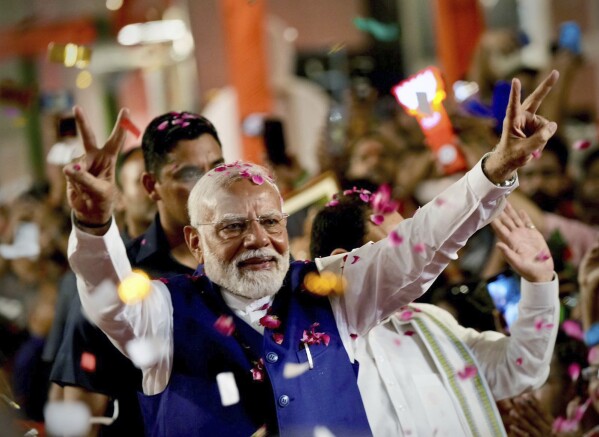
Prime Minister Narendra Modi greets supporters as he arrives at Bharatiya Janata Party (BJP) headquarters in New Delhi, India, Tuesday, June 4, 2024. (AP Photo/Manish Swarup)
Prime Minister Narendra Modi greets supporters as he arrives at Bharatiya Janata Party (BJP) headquarters in New Delhi, India, Tuesday, June 4, 2024. (AP Photo/Manish Swarup)
Prime Minister Narendra Modi promises “new chapter of big decisions” after declaring victory for his coalition.
But if his BJP is indeed forced to form a coalition, the party would likely “be heavily dependent on the goodwill of its allies, which makes them critical players who we can expect will extract their pound of flesh, both in terms of policymaking as well as government formation,” said Milan Vaishnav, director of the South Asia Program at the Carnegie Endowment for International Peace.
Modi claims victory for alliance
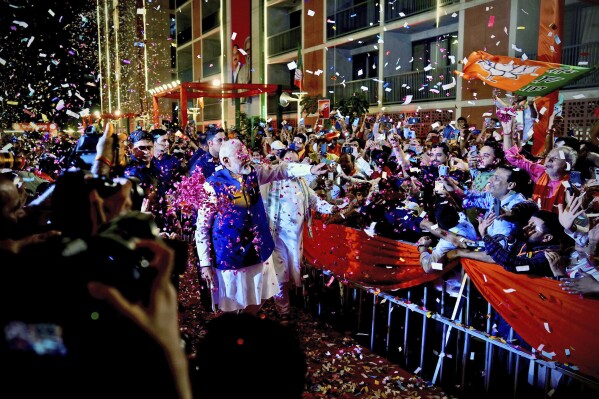
Prime Minister Narendra Modi is greeted by supporters as he arrives at Bharatiya Janata Party (BJP) headquarters in New Delhi, India, Tuesday, June 4, 2024. (AP Photo/Manish Swarup)
Prime Minister Narendra Modi is greeted by supporters as he arrives at Bharatiya Janata Party (BJP) headquarters in New Delhi, India, Tuesday, June 4, 2024. (AP Photo/Manish Swarup)
Prime Minister Narendra Modi claimed victory for his alliance, despite a lackluster performance from his own party as it faced a stronger than expected challenge from the opposition, which pushed back against the leader’s mixed economic record and polarizing politics.
Modi said that his National Democratic Alliance will form the government for the third consecutive time.
“Today’s victory is the victory of the world’s largest democracy,” he said, speaking at his party headquarters.
For the first time since Modi’s Bharatiya Janata Party swept to power in 2014, it appeared unlikely that it would secure a majority on its own – but the prime minister’s coalition was still expected to be elected to a third five-year term in the world’s largest democratic exercise.
If Modi does have to rely on coalition support to govern, it would be a stunning blow for the 73-year-old, who had hoped for a landslide victory.
60% of the seats have been called
As Prime Minister Narendra Modi claims victory for his alliance, 329 of 543 seats have been decided, according to India’s Election Commission. Counting is expected to continue through the night.
Modi begins address to supporters
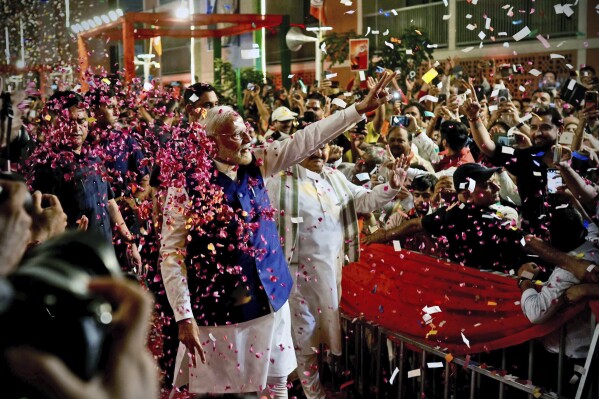
Prime Minister Narendra Modi is greeted by supporters as he arrives at Bharatiya Janata Party (BJP) headquarters in New Delhi, India, Tuesday, June 4, 2024. (AP Photo/Manish Swarup)
Prime Minister Narendra Modi is greeted by supporters as he arrives at Bharatiya Janata Party (BJP) headquarters in New Delhi, India, Tuesday, June 4, 2024. (AP Photo/Manish Swarup)
Narendra Modi’s Bharatiya Janata Party and its National Democratic Alliance has yet to secure the 272 seats needed for a parliamentary majority, but the prime minister has declared “a very big win.”
WATCH: A look at India’s economy under Modi
India’s Prime Minister Narendra Modi swept to power a decade ago on promises to transform India’s economy, and as he seeks a third term as prime minister, it would be hard to argue he hasn’t made strides.
▶ Read more about the growth of India’s economy — and why some feel left behind.
What is the National Democratic Alliance?
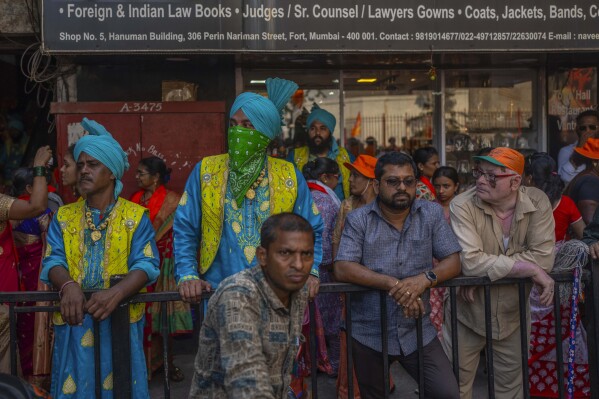
Supporters of National Democratic Alliance watch as their candidates arrive to file nomination papers ahead of national elections in Mumbai, India, Monday, April 29, 2024. (AP Photo/Rafiq Maqbool)
Supporters of National Democratic Alliance watch as their candidates arrive to file nomination papers ahead of national elections in Mumbai, India, Monday, April 29, 2024. (AP Photo/Rafiq Maqbool)
The National Democratic Alliance, an Indian political coalition, is led by Prime Minister Narendra Modi’s Hindu nationalist Bharatiya Janata Party. It was founded in 1998 and comprises center-right and right-wing political parties.
The coalition’s first chair was former BJP Prime Minister Atal Bihari Vajpayee. The coalition ruled from 1998 to 2004, but then was out of power until 2014, when Modi was first elected as the prime minister.
BJP’s key allies in the NDA include more than a dozen regional parties, including the Telugu Desam Party, Janta Dal (United), Pattali Makkal Katchi, the Republican Parry of India (Athwale Group) and Shiv Sena.
The NDA could be key to Modi retaining his position. In the past two elections, the BJP has secured an outright majority, but early figures indicate it might need the coalition to reach that threshold.
12 hours in, the tally of seats won so far
More than 12 hours after vote counting started, India’s Election Commission reports that the ruling Bharatiya Janata Party has won 140 seats while the Congress party has won 55.
272 seats are needed to secure a majority. Preliminary results indicate Modi’s BJP will need to rely on its coalition partners to achieve that.
Modi expected to address supporters soon
Prime Minister Narendra Modi has arrived at Bharatiya Janata Party headquarters in New Delhi, where supporters are spilling out into the road.
Who is the Samajwadi Party allied with?
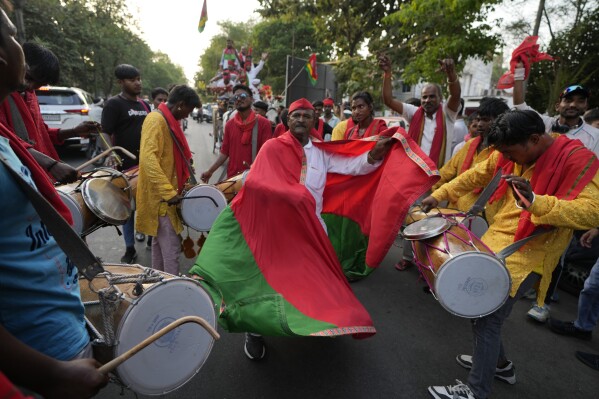
Samajwadi Party supporters dance as they celebrate their party’s lead during the counting of votes in India’s national election in Lucknow, India, Tuesday, June 4, 2024. (AP Photo/Rajesh Kumar Singh)
Samajwadi Party supporters dance as they celebrate their party’s lead during the counting of votes in India’s national election in Lucknow, India, Tuesday, June 4, 2024. (AP Photo/Rajesh Kumar Singh)
Prime Minister Narendra Modi’s Hindu nationalist party is facing a major upset in India’s most populous state at the hands of a powerful regional group, Samajwadi Party or Socialist Group.
The Samajwadi Party, founded in 1992 and now led by Akhilesh Yadav, has already won 10 seats in Uttar Pradesh state and was leading in another 28 constituencies. It is part of the Congress-led INDIA alliance, which is facing off against the BJP-led National Democratic Alliance.
Modi’s BJP has won in 12 districts (including Modi’s own Varanasi seat) and is leading in 20 constituencies. Exit polls had predicted a landslide victory for the BJP in the state.
“In this election, it seems Lord Ram has deserted the BJP,” Samajwadi spokesperson Rajendra Chaudhry said.
Meet the contenders: Narendra Modi
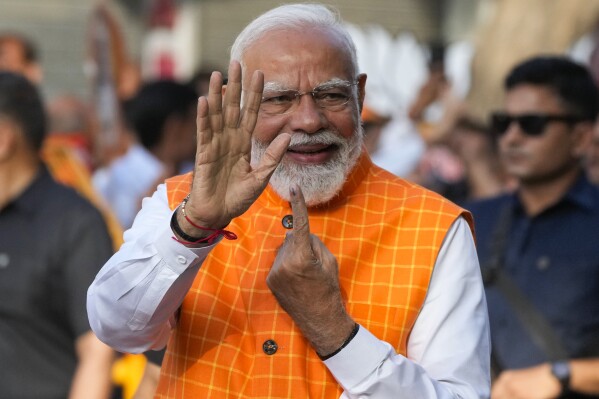
Indian Prime Minister Narendra Modi, shows the indelible ink mark on his index finger after casting his vote during the third phase of general elections, in Ahmedabad, Gujarat, India, Tuesday, May 7, 2024. (AP Photo/Ajit Solanki)
Indian Prime Minister Narendra Modi, shows the indelible ink mark on his index finger after casting his vote during the third phase of general elections, in Ahmedabad, Gujarat, India, Tuesday, May 7, 2024. (AP Photo/Ajit Solanki)
The 73-year-old is one of India’s most beloved — and polarizing — leaders. He’s already won twice, first in 2014 and then in 2019, and is now seeking a hattrick victory.
His supporters see him as a self-made, strong leader who has improved India’s standing on the global stage, and credit his pro-business policies with making the economy the world’s fifth-largest. At the same time, his rule has seen brazen attacks against minorities, particularly Muslims.
India’s democracy, critics say, is faltering and Modi has increasingly blurred the line between religion and state. But both agree on one thing: Modi has achieved staying power by making Hindu nationalism acceptable — desirable, even — to a nation of 1.4 billion that for decades prided itself on secularism and diversity.
WATCH: Why India’s election was held in phases
Millions of Indians are voting in a six-week long national election in a referendum on Narendra Modi, the populist prime minister who has championed an assertive brand of Hindu nationalist politics. The voters will cast ballots in the first round of voting across 21 states. Over 970 million voters will elect 543 members for the lower house of Parliament for five years during the staggered elections that will run until June 1. The votes will be counted on June 4. (AP Video by Piyush Nagpal)
Each phase was held on a single day, with voting in several constituencies across multiple states. The staggered polling allowed the government to deploy tens of thousands of troops to prevent violence and transport election officials and voting machines.
How some Bollywood films have promoted nationalism
For more than a century, Bollywood has unified India, a country riven with religious, caste and political divide. It’s been a rare industry where religion has been least influential in deciding the success of filmmakers and actors. Bollywood films have also championed political diversity and religious harmony.
That culture, however, appears to be under threat.
Under Narendra Modi’s Hindu nationalist government, many filmmakers have made movies on bygone Hindu kings extolling their bravery. Boisterous and action-packed movies valorizing the Indian Army have become box office successes. Political dramas and biopics that eulogize Hindu nationalists are the norm.
In most of these films, the stock villains are medieval Muslim rulers, leftist or opposition leaders, free thinkers or rights activists — and neighboring Pakistan.
▶ Read more about how some in the Hindi film industry have embraced Modi.
Modi says election is ‘historical feat’
Prime Minister Narendra Modi says his coalition is on the path to a third straight term in government after India’s marathon election.
“People have placed their faith in NDA, for a third consecutive time! This is a historical feat in India’s history,” Modi on Tuesday said in a post on X, referring to the National Democratic Alliance which his party heads. He said he will continue to work and fulfil the aspirations of the people.
As Modi posted his comment, his coalition had won 128 seats and led in 157 races according to the Election Commission. A total of 272 seats were needed to form a majority government.
WATCH: Lucknow resident highlights economic struggles
For Payal, a resident of the northern city of Lucknow who uses only one name, the election was about the economy and India’s vast number of people living in poverty. “People are suffering, there are no jobs, people are in such a state that their kids are compelled to make and sell tea on the roadside,” Payal said. “This is a big deal for us. If we don’t wake up now, when will we?”
PHOTOS: Parties across India celebrate election results
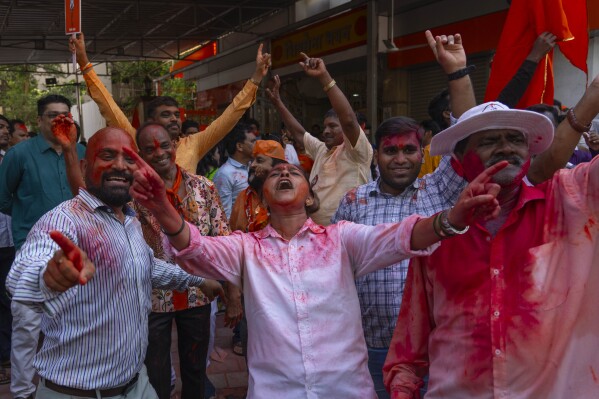
Supporters of Shiv Sena (Uddhav Balasaheb Thackeray) dance as they celebrate their party’s lead during the counting of votes in India’s national election in Mumbai, India, Tuesday, June 4, 2024. (AP Photo/Rafiq Maqbool)

Supporters of Congress Party dance as they celebrate their party’s lead during the counting of votes in India’s national election in Mumbai, India, Tuesday, June 4, 2024. (AP Photo/Rafiq Maqbool)

Faces of Trinamool Congress Party supporters smeared with green colour display victory sign as they celebrate the election results in Kolkata, India, Tuesday, June 4, 2024. Prime Minister Narendra Modi’s Hindu nationalist party showed a comfortable lead Tuesday, according to early figures reported by India’s Election Commission, but was facing a stronger challenge from the opposition than had been expected. (AP Photo/Bikas Das)

Dravida Munnetra Kazhagam (DMK) party supporters cheer as they follow proceedings of the vote counting at their party headquarters in Chennai, India, Tuesday, June 4, 2024. India began counting more than 640 million votes Tuesday in the world’s largest democratic exercise, which was widely expected to return Prime Minister Narendra Modi to a third term after a decade in power. (AP Photo/Mahesh Kumar A.)

Bharatiya Janata Party (BJP) supporters shout slogans as they celebrate their party’s lead during the counting of votes outside the party office in Srinagar, Indian controlled Kashmir, Tuesday, June 4, 2024. (AP Photo/Dar Yasin)

Congress party supporters cheer as they follow proceedings of vote counting at their party headquarters in New Delhi, India, Tuesday, June 4, 2024. India began counting more than 640 million votes Tuesday in the world’s largest democratic exercise, which was widely expected to return Prime Minister Narendra Modi to a third term after a decade in power. (AP Photo/Altaf Qadri)

A band plays music as Bharatiya Janata Party (BJP) supporters dance inside the party office after hearing of a candidate’s victory during the counting in India’s national election, in New Delhi, India, Tuesday, June 4, 2024. xPrime Minister Narendra Modi’s Hindu nationalist party showed a comfortable lead Tuesday, according to early figures reported by India’s Election Commission, but was facing a stronger challenge from the opposition than had been expected. (AP Photo/Manish Swarup)

Samajwadi Party supporters dance as they celebrate their party’s lead during the counting of votes in India’s national election in Lucknow, India, Tuesday, June 4, 2024. (AP Photo/Rajesh Kumar Singh)

Bharatiya Janata Party (BJP) supporters light firecrackers after hearing of a candidate’s victory during the counting of votes in India’s national election, in New Delhi, India, Tuesday, June 4, 2024. (AP Photo/Manish Swarup)
Supporters of Shiv Sena (Uddhav Balasaheb Thackeray) dance as they celebrate their party’s lead during the counting of votes in India’s national election in Mumbai, India, Tuesday, June 4, 2024. (AP Photo/Rafiq Maqbool)
Supporters of Shiv Sena (Uddhav Balasaheb Thackeray) dance as they celebrate their party’s lead during the counting of votes in India’s national election in Mumbai, India, Tuesday, June 4, 2024. (AP Photo/Rafiq Maqbool)
Supporters of Congress Party dance as they celebrate their party’s lead during the counting of votes in India’s national election in Mumbai, India, Tuesday, June 4, 2024. (AP Photo/Rafiq Maqbool)
Supporters of Congress Party dance as they celebrate their party’s lead during the counting of votes in India’s national election in Mumbai, India, Tuesday, June 4, 2024. (AP Photo/Rafiq Maqbool)
Faces of Trinamool Congress Party supporters smeared with green colour display victory sign as they celebrate the election results in Kolkata, India, Tuesday, June 4, 2024. Prime Minister Narendra Modi’s Hindu nationalist party showed a comfortable lead Tuesday, according to early figures reported by India’s Election Commission, but was facing a stronger challenge from the opposition than had been expected. (AP Photo/Bikas Das)
Faces of Trinamool Congress Party supporters smeared with green colour display victory sign as they celebrate the election results in Kolkata, India, Tuesday, June 4, 2024. Prime Minister Narendra Modi’s Hindu nationalist party showed a comfortable lead Tuesday, according to early figures reported by India’s Election Commission, but was facing a stronger challenge from the opposition than had been expected. (AP Photo/Bikas Das)
Dravida Munnetra Kazhagam (DMK) party supporters cheer as they follow proceedings of the vote counting at their party headquarters in Chennai, India, Tuesday, June 4, 2024. India began counting more than 640 million votes Tuesday in the world’s largest democratic exercise, which was widely expected to return Prime Minister Narendra Modi to a third term after a decade in power. (AP Photo/Mahesh Kumar A.)
Dravida Munnetra Kazhagam (DMK) party supporters cheer as they follow proceedings of the vote counting at their party headquarters in Chennai, India, Tuesday, June 4, 2024. India began counting more than 640 million votes Tuesday in the world’s largest democratic exercise, which was widely expected to return Prime Minister Narendra Modi to a third term after a decade in power. (AP Photo/Mahesh Kumar A.)
Bharatiya Janata Party (BJP) supporters shout slogans as they celebrate their party’s lead during the counting of votes outside the party office in Srinagar, Indian controlled Kashmir, Tuesday, June 4, 2024. (AP Photo/Dar Yasin)
Bharatiya Janata Party (BJP) supporters shout slogans as they celebrate their party’s lead during the counting of votes outside the party office in Srinagar, Indian controlled Kashmir, Tuesday, June 4, 2024. (AP Photo/Dar Yasin)
Congress party supporters cheer as they follow proceedings of vote counting at their party headquarters in New Delhi, India, Tuesday, June 4, 2024. India began counting more than 640 million votes Tuesday in the world’s largest democratic exercise, which was widely expected to return Prime Minister Narendra Modi to a third term after a decade in power. (AP Photo/Altaf Qadri)
Congress party supporters cheer as they follow proceedings of vote counting at their party headquarters in New Delhi, India, Tuesday, June 4, 2024. India began counting more than 640 million votes Tuesday in the world’s largest democratic exercise, which was widely expected to return Prime Minister Narendra Modi to a third term after a decade in power. (AP Photo/Altaf Qadri)
A band plays music as Bharatiya Janata Party (BJP) supporters dance inside the party office after hearing of a candidate’s victory during the counting in India’s national election, in New Delhi, India, Tuesday, June 4, 2024. xPrime Minister Narendra Modi’s Hindu nationalist party showed a comfortable lead Tuesday, according to early figures reported by India’s Election Commission, but was facing a stronger challenge from the opposition than had been expected. (AP Photo/Manish Swarup)
A band plays music as Bharatiya Janata Party (BJP) supporters dance inside the party office after hearing of a candidate’s victory during the counting in India’s national election, in New Delhi, India, Tuesday, June 4, 2024. xPrime Minister Narendra Modi’s Hindu nationalist party showed a comfortable lead Tuesday, according to early figures reported by India’s Election Commission, but was facing a stronger challenge from the opposition than had been expected. (AP Photo/Manish Swarup)
Samajwadi Party supporters dance as they celebrate their party’s lead during the counting of votes in India’s national election in Lucknow, India, Tuesday, June 4, 2024. (AP Photo/Rajesh Kumar Singh)
Samajwadi Party supporters dance as they celebrate their party’s lead during the counting of votes in India’s national election in Lucknow, India, Tuesday, June 4, 2024. (AP Photo/Rajesh Kumar Singh)
Bharatiya Janata Party (BJP) supporters light firecrackers after hearing of a candidate’s victory during the counting of votes in India’s national election, in New Delhi, India, Tuesday, June 4, 2024. (AP Photo/Manish Swarup)
Bharatiya Janata Party (BJP) supporters light firecrackers after hearing of a candidate’s victory during the counting of votes in India’s national election, in New Delhi, India, Tuesday, June 4, 2024. (AP Photo/Manish Swarup)
Across India, supporters of various political parties have been celebrating results as they trickle in with colored powder, fireworks, drums and more.
How Hindu nationalism became mainstream during Modi’s reign
Hindu nationalism, once a fringe ideology in India, is now mainstream. Nobody has done more to advance this cause than Prime Minister Narendra Modi, one of India’s most beloved and polarizing political leaders.
Hindu nationalism, once a fringe ideology in India, is now mainstream. Nobody has done more to advance this cause than Prime Minister Narendra Modi, one of India’s most beloved and polarizing political leaders.
And no entity has had more influence on his political philosophy and ambitions than a paramilitary, right-wing group founded nearly a century ago and known as the RSS.
▶ Read more about how Hindu nationalism has become mainstream over the past decade.
Who is Arvind Kejriwal and why is he in jail?
Aam Aadmi Party leader Arvind Kejriwal greets his supporters from a vehicle during a roadshow in New Delhi, India, Saturday, May 11, 2024. (AP Photo/Altaf Qadri)
Aam Aadmi Party leader Arvind Kejriwal greets his supporters from a vehicle during a roadshow in New Delhi, India, Saturday, May 11, 2024. (AP Photo/Altaf Qadri)
As votes are being counted, Arvind Kejriwal, 55, is likely keeping track — from jail.
One of India’s most consequential opposition leaders, Kejriwal was arrested in March over alleged corruption charges, and let out on bail in May for a few weeks. He campaigned heavily during this time in his stronghold of New Delhi, India’s capital, as well as a few other cities before heading back to jail.
Kejriwal stormed into Indian politics in 2012 as he launched the anti-corruption Aam Aadmi Party, or Common People’s Party.
Since then, he has emerged as a fierce Modi rival, especially in New Delhi and Punjab state, where his party is in power.
His arrest and the ensuing saga dominated headlines, as he and his party accused Modi’s government of engineering his arrest to keep him out of the race. The government has denied this.
Kejriwal’s AAP is part of a broad alliance of opposition parties called INDIA, the main challenger to Modi’s BJP in this election.
Rahul Gandhi says results so far are a message to Modi
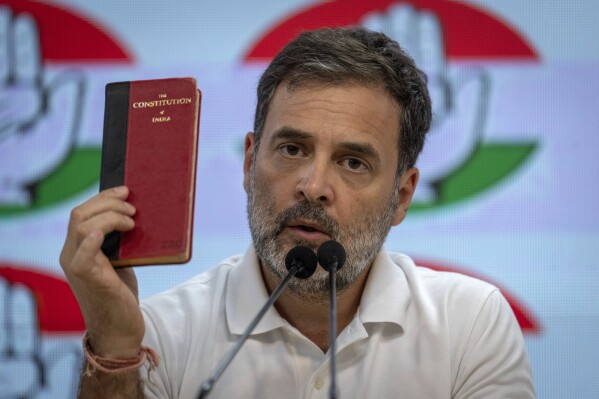
Congress Party leader Rahul Gandhi holds a copy of the Indian Constitution as he addresses a press conference at the party headquarters in New Delhi, India, Tuesday, June 4, 2024. (AP Photo/Altaf Qadri)
Congress Party leader Rahul Gandhi holds a copy of the Indian Constitution as he addresses a press conference at the party headquarters in New Delhi, India, Tuesday, June 4, 2024. (AP Photo/Altaf Qadri)
Rahul Gandhi, the face of the Congress party’s campaign and would-be prime minister, said the preliminary results showed India does not want Narendra Modi.
“People’s clear message to PM Modi and Home Minister Amit Shah is that we don’t want you to run the nation,” Gandhi said at a Congress party press conference around 10 hours into the vote count. “The poorest of this country have defended the constitution of India.”
Flanked by Congress leaders, including mother Sonia Gandhi, the Nehru-Gandhi dynasty scion brandished a copy of the constitution.
Despite a stronger-than-expected showing from Congress’ INDIA alliance thus far, Modi is still expected to secure a third term as prime minister.
Nearly 20% of seats have been called
The counting is ticking along more than 10 hours after it began, and results have now been called for 103 parliamentary seats out of a total of 543.
Modi’s National Democratic Alliance had won 67 seats, with 62 of them going to his Hindu nationalist Bharatiya Janata Party, according to India’s Election Commission. The opposing INDIA coalition had bagged 31 seats, with the main Congress party winning 27 of them. The remaining five seats went to other regional parties.
Congress party calls strong showing a ‘win for democracy’
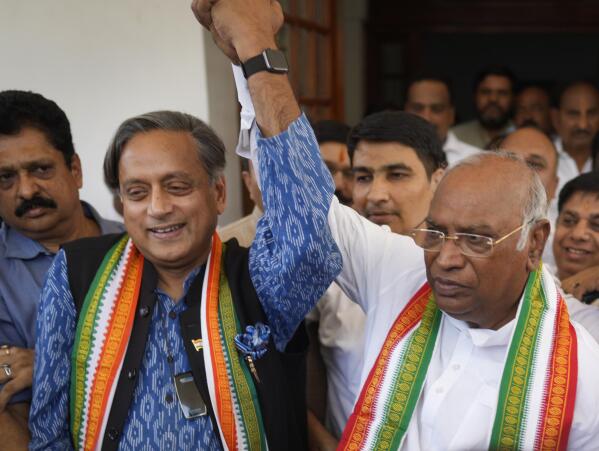
Congress party leader Shashi Taroor, and contender for the party president position, left, raises hands with newly elected president Mallikarjun Kharge in New Delhi, India, Wednesday, Oct. 19, 2022. (AP Photo/Manish Swarup)
Congress party leader Shashi Taroor, and contender for the party president position, left, raises hands with newly elected president Mallikarjun Kharge in New Delhi, India, Wednesday, Oct. 19, 2022. (AP Photo/Manish Swarup)
India’s opposition Congress party has called its alliance’s strong showing in the polls a “win for democracy” and a “moral and political loss” for Prime Minister Narendra Modi.
Congress party President Mallikarjun Kharge just addressed a press conference in New Delhi, saying that because no party had a clear majority, the mandate was against Modi.
“Our fight has not ended yet. We will continue to fight for the country’s development, for the constitution, for the benefit of the people,” Kharge said.
Modi’s coalition led in a majority of seats Tuesday in India’s general election, according to early figures, but faced a stronger challenge from the opposition than expected after it pushed back against the leader’s mixed economic record and polarizing politics. Modi was still widely expected to be elected to a third five-year term in the world’s largest democratic exercise.
WATCH: BJP supporters celebrate in Srinagar
Bharatiya Janata Party (BJP) supporters celebrate in Srinagar as vote counting is underway in India’s 2024 Lok Sabha election. AP video: Dar Yasin
10 hours into counting, here’s what partial tallies say
Some 10 hours into counting, partial tallies reported by India’s Election Commission showed Narendra Modi’s Bharatiya Janata Party was ahead in 196 constituencies and had won 45, including one uncontested, of 543 parliamentary seats. The main opposition Congress party led in 83 constituencies and had won 15.
A total of 272 seats are needed for a majority. In 2019, the BJP won 303 seats, while they secured 282 in 2014 when Modi first came to power.
Modi’s party is part of the National Democratic Alliance, whose members led in 236 constituencies and won 50, according to the partial count. The Congress party is part of the INDIA alliance, which led in 211 constituencies and had won 19.
The Election Commission does not release data on the percentage of votes tallied.
How often does India hold elections?

India’s general elections are held every five years. There are no specified term limits for lawmakers and thus no limit on how many years a prime minister can serve. Narendra Modi has already been in power for a decade. Should he win a third term and finish it out, he’ll near the record of the longest-serving prime minister, Jawaharlal Nehru.
What kind of electoral system does India have?
India employs a first-past-the-post multiparty electoral system. That means for individual contests, whoever receives the most votes wins. To win a parliamentary majority — and thus the premiership — a party or a coalition of parties must secure at least 272 seats (543 seats are up for a vote). India’s electoral system is similar to the U.K.’s.
WATCH: Congress supporters in Mumbai
Congress party supporters celebrate in Mumbai as vote counting is underway in India’s 2024 Lok Sabha election. (AP video: Rafiq Maqbool)
What constituency does Modi represent?
India’s Prime Minister Narendra Modi filed his nomination on Tuesday to run for a third term in India’s general election. Modi hopes to retain his seat in the holy Hindu city, his constituency, from where he ran and won, first in 2014 and then again in 2019. (AP video shot by Rajesh Kumar Singh)
Although Narendra Modi is the former chief minister of Gujarat, the incumbent prime minister has retained his seat in Varanasi.
It’s the constituency from which he first ran and won in 2014. Located in Uttar Pradesh, India’s most populous state, Varanasi is a holy Hindu city. It’s about 1,350 kilometers (840 miles) east of Modi’s hometown of Vadnagar in Gujarat state.
Modi wins his own seat in Varanasi
A woman shows her index fingers marked with an indelible ink as she poses for a photograph next to a cutout portrait of Indian Prime Minister Narendra Modi after casting her vote in Varanasi, India (AP Photo/Rajesh Kumar Singh)
A woman shows her index fingers marked with an indelible ink as she poses for a photograph next to a cutout portrait of Indian Prime Minister Narendra Modi after casting her vote in Varanasi, India (AP Photo/Rajesh Kumar Singh)
Prime Minister Narendra Modi has won his seat from the Hindu holy city of Varanasi, the constituency from where he ran and won, first in 2014 and then again in 2019, India’s election commission reported.
Modi, who won by more than 152,000 votes, secured 54% of total votes. He was pitted against opposition Congress party’s Ajai Rai, who secured 40% of the votes.
The holy city is located on the banks of the revered Ganges River and is part of Uttar Pradesh state, India’s most populous, with around 200 million people.
Campaign marked by Modi’s incendiary rhetoric against Muslims
Indian Prime Minister Narendra Modi, in a white waistcoat, and Yogi Adityanath, Chief Minister of Uttar Pradesh greet supporters from a vehicle during a roadshow in Varanasi, India, Monday, May 13, 2024. (AP Photo/Rajesh Kumar)
Indian Prime Minister Narendra Modi, in a white waistcoat, and Yogi Adityanath, Chief Minister of Uttar Pradesh greet supporters from a vehicle during a roadshow in Varanasi, India, Monday, May 13, 2024. (AP Photo/Rajesh Kumar)
In campaign rallies, Narendra Modi has called Muslims “infiltrators” and said they “have too many children,” referring to a Hindu nationalist trope that Muslims produce more children with the aim of outnumbering Hindus in India. He has also accused the rival Indian National Congress party of scheming to “loot” wealth from the country’s Hindus and redistribute it among Muslims, who comprise 14% of India’s more than 1.4 billion people.
Modi had kicked off his campaign with a focus on economic progress, promising he would make India a developed nation by 2047. But he and the ruling BJP doubled down heavily on their Hindu nationalism platform, with Modi employing some of his most divisive rhetoric in his decade in power.
The Congress party filed a complaint with the Election Commission of India, alleging Modi broke rules that bar candidates from engaging in any activity that aggravates religious tensions.
Analysts say the change in tone came as the BJP targeted a supermajority by consolidating votes among the majority Hindu population — a number that now seems out of reach. They say Modi’s party also ratcheted up polarizing speeches to distract voters from larger issues, like unemployment and economic distress, that the opposition has focused on.
BJP loses seat in Ayodhya, home to Ram temple
A polling officer applies indelible ink mark on the finger of a voter during the fifth round of multi-phase national elections in Ayodhya, India, Monday, May 20, 2024. (AP Photo/Rajesh Kumar Singh)
A polling officer applies indelible ink mark on the finger of a voter during the fifth round of multi-phase national elections in Ayodhya, India, Monday, May 20, 2024. (AP Photo/Rajesh Kumar Singh)
Narendra Modi’s BJP have lost their seat in Ayodhya, a deeply symbolic loss for the party after the prime minister opened a grand but controversial Hindu temple there in January.
The BJP candidate, Lallu Singh, lost to a candidate put up by the regional Samajwadi Party, Singh’s poll agent Kamlesh Srivastava told The Associated Press. Singh had held the seat since 2014.
Modi and his party have heavily campaigned on this temple dedicated to Lord Ram, built on the historic ruins of a mosque that was destroyed by Hindu mobs in 1992.
In this photograph released by Indian Government Press Information Bureau, Indian Prime Minister, arrives to lead the opening of a temple dedicated to Hinduism’s Lord Ram in Ayodhya, India, Monday, Jan. 22, 2024. (Press Information Bureau via AP)
In this photograph released by Indian Government Press Information Bureau, Indian Prime Minister, arrives to lead the opening of a temple dedicated to Hinduism’s Lord Ram in Ayodhya, India, Monday, Jan. 22, 2024. (Press Information Bureau via AP)
Experts said the January opening, where Modi performed rituals inside the temple, marked the unofficial start of his campaign as they hoped it would resonate with his Hindu majority voters. Modi’s government had turned the event into a national occasion by organizing live screenings across the country and closing offices for half a day.
WATCH: Scenes outside the BJP’s headquarters in New Delhi
Bharatiya Janata Party (BJP) supporters celebrate in Delhi as vote counting is underway in India’s 2024 Lok Sabha election. (AP video: Manish Swarup)
Outside the BJP party office, a Modi-branded water bottle
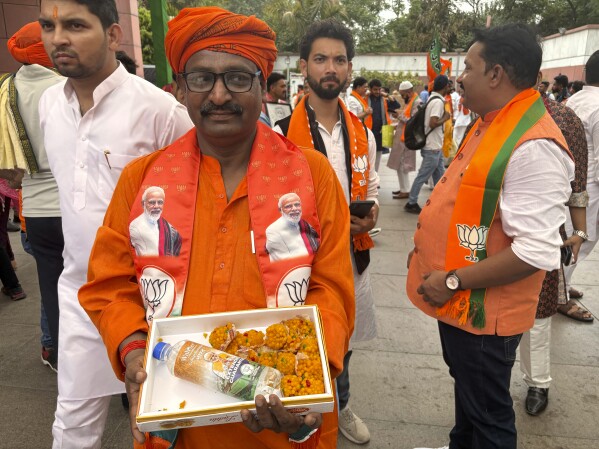
Outside the BJP party office in New Delhi, supporter Vinod Kumar Vidyarthi sported a stole emblazoned with Modi’s likeness and toted a Modi-branded water bottle and sweets.
Despite the sweets, he had strong words regarding the election and the Hindu nationalist party he supports: “Our party will form the government. We had traitors within us. After we form the government, it will be a victory for Hindus and we will chase away all those who betrayed us.”
PHOTOS: One village’s polling officers? All women
Polling officers Dekule Kapfo, Neke W Konyak, Neichutuonuo Yhome and Nukutholu Nienu prepare election-related paperwork on the eve of polling (AP Photo/Yirmiyan Arthur)
Polling officers Dekule Kapfo, Neke W Konyak, Neichutuonuo Yhome and Nukutholu Nienu prepare election-related paperwork on the eve of polling (AP Photo/Yirmiyan Arthur)
The Northern Angami constituency of Chedema village is Nagaland’s first to be solely managed by women polling officers. It was the idea of Kumar Ramnikant, the administrative head of Kohima district, in hopes of breaking job stereotypes.
“Women are more systematic. They take every sentence seriously, whereas men have an easy attitude,” said Zhoto Khamo, an officer who has supervised many elections.
▶ Read more about these polling officers and see more photos of the station.
The seats won so far
The vote counting is still carrying on, but results have been called for 28 parliamentary seats out of 542 so far.
Narendra Modi’s Bharatiya Janata Party has won 19 seats, according to India’s Election Commission, while its main opposition Congress party bagged 4 seats. The rest went to different regional parties.
Vote tallying is expected to take all day, but the count so far shows Modi’s party leading in 225 constituencies with the Congress ahead in 93.
Why India’s election matters to the world
The polls are seen as a test for India’s democratic and secular traditions, which critics say have seen a slow erosion under Narendra Modi’s 10-year rule. It also tests the limits of a populist leader who has risen to power by mixing religion with politics on a Hindu-first platform.
India’s clout on the global stage has risen under Modi. It’s seen by Western nations as a counterweight to Chinese aggression in the region even as New Delhi maintains its historic ties with Russia. And its large economy, one of the fastest growing in the world, has only boosted its rise as an emerging global power.
Why there won’t be celebrations in Modi’s home state
Early leads from India’s election commission projected Narendra Modi’s ruling Bharatiya Janata Party was leading in 25 of 26 seats in the prime minister’s home state of Gujarat. But party leaders said they were not celebrating victory because of a recent fire at an amusement park in the state that killed 27 people.
A massive fire broke out last month at an amusement park in the state’s Rajkot city. Those killed included children.
“We had decided that there will be no celebratory victory or beating of drums. So we are not celebrating,” said C. R. Patil, a senior leader from Modi’s party.
Meet the contenders: Rahul Gandhi
The 53-year-old is the scion of modern India’s most powerful political dynasty. He is the great-grandson of the country’s first prime minister, Jawaharlal Nehru. His grandmother and father also held the top job and were each assassinated.
He is the star face for the opposition Congress party, which governed India for nearly 55 years after the country gained independence from the British in 1947. This time, he and his Congress party are leading the main opposition alliance, called INDIA, against Narendra Modi’s BJP.
While his family connections have helped retain some loyal voters, they have also worked against him — especially in the past two elections, where he suffered huge losses against Modi, who refers to Gandhi as an out-of-touch elite, coasting on his surname.
On the campaign trail, Gandhi has called Modi a dictator ruining India’s democracy. He has attacked Modi and the BJP over recent anti-Muslim rhetoric. And his party is hoping to benefit from economic distress, including high unemployment.
Modi may need a coalition to keep his job
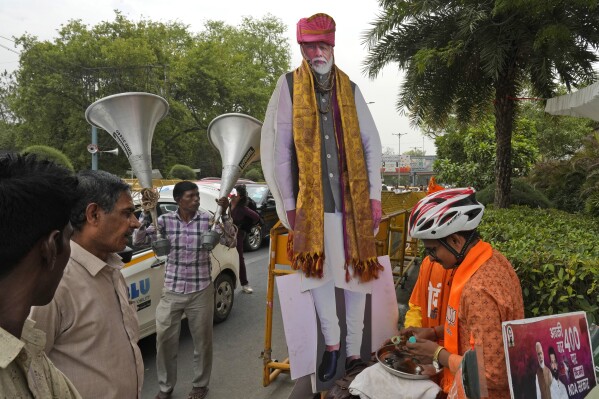
A Bharatiya Janta Party supporter prepares to offer prayers to the cut-out of Indian Prime Minister Narendra Modi outside their party headquarters in New Delhi, India, Tuesday, June 4, 2024 (AP Photo/Manish Swarup)
A Bharatiya Janta Party supporter prepares to offer prayers to the cut-out of Indian Prime Minister Narendra Modi outside their party headquarters in New Delhi, India, Tuesday, June 4, 2024 (AP Photo/Manish Swarup)
Prime Minister Narendra Modi’s ruling Hindu nationalist party appears to be falling short of a majority in the early vote count. If these trends hold, it would be a stunning setback to the populist who has never relied on coalition partners to govern.
Modi’s party is still expected to form the government and return as the prime minister for a rare third consecutive term as his National Democratic Alliance was leading in about 290 constituencies — ahead of the 272 seats needed for a majority. Modi’s Bharatiya Janata Party alone was leading in 242 seats.
A coalition would, however, diminish Modi’s power as a strongman leader who won his party landslide victories in 2014 and 2019 elections.
In such a scenario, his BJP would likely “be heavily dependent on the goodwill of its allies, which makes them critical players who we can expect will extract their pound of flesh, both in terms of policymaking as well as government formation,” said Milan Vaishnav, director of the South Asia Program at the Carnegie Endowment for International Peace.
“This would be truly, you know, uncharted territory, both for Indians as well as for the prime minister,” Vaishnav said.
Since coming to power in 2014, Modi’s BJP has governed in a coalition government but has always held a majority on its own.
WATCH: BJP supporters in Assam
Bharatiya Janata Party (BJP) supporters celebrate in Guwahati as party seeks majority for third term in Assam. (AP video: Anupam Nath)
Climate change’s role in the election
As hundreds of millions headed to the polls, they did so amid sweltering heat and unpredictable weather extremes worsened by human-caused climate change. That climate change has led to losses of livelihood, forced migration and increasingly difficult living conditions.
India’s top political parties made promises to address climate change and reduce emissions in their election manifestos — but little of that was evident on the campaign trail.
Here’s a look at what climate change has wrought in the country:
- Western and central India: extreme heat and longer droughts
- Coastal regions: stronger and more frequent cyclones
- Northeastern India: unpredictable and increased flooding
- Himalayas: melting glaciers and intense rain
▶ Read more about how climate change has affected the election.
