| June 16, 2025 08:05:59 AM |
|
|
| June 16, 2025 08:05:59 AM |
|
|
As Israel and Iran continue to trade missile attacks, President Donald Trump rejected a plan presented by Israel to the U.S. to kill Iran’s Supreme Leader Ayatollah Ali Khamenei, according to a U.S. official familiar with the matter. Welcome to this week’s edition of AP Ground Game. |
Policy changes, but facts endure. AP delivers accurate, fact-based journalism to keep the world informed in every administration. Support independent reporting today. Donate. |
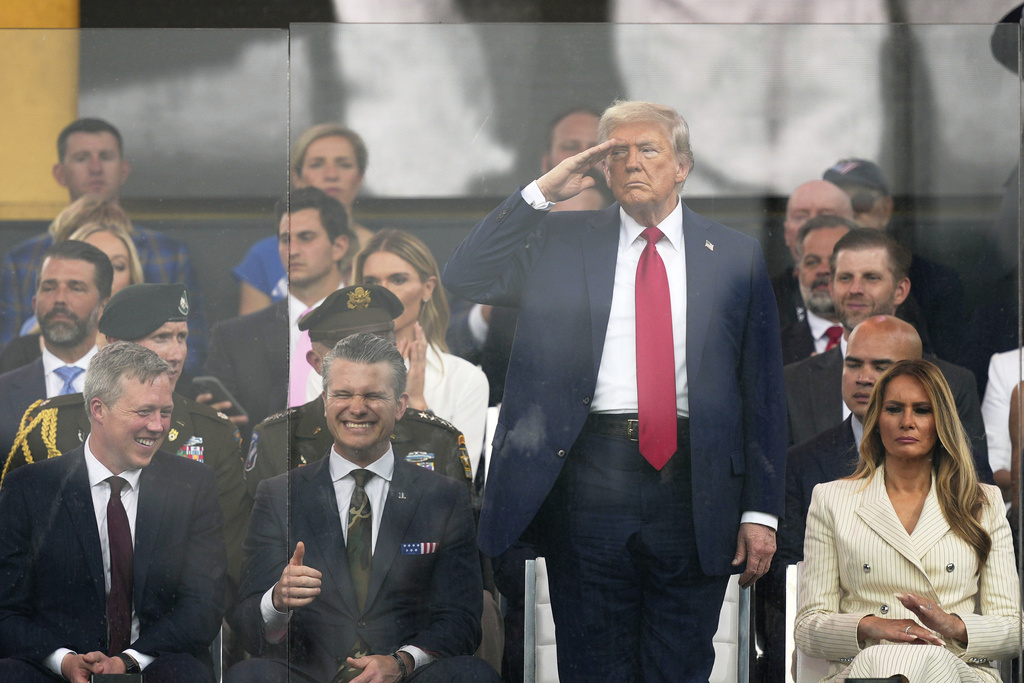
President Donald Trump salutes as attends a military parade commemorating the Army's 250th anniversary on Saturday, June 14, 2025, in Washington, as Secretary of the Army Daniel Driscoll, Defense Secretary Pete Hegseth, and first lady Melania Trump, watch. (AP Photo/Julia Demaree Nikhinson) |
US official says Trump rejected Israeli plan to kill Iran's supreme leader |
The Israelis informed the Trump administration in recent days that they had developed a credible plan to kill Khamenei. After being briefed on the plan, the White House made clear to Israeli officials that Trump was opposed to the Israelis making the move, according to the official, who was not authorized to comment on the sensitive matter and spoke on the condition of anonymity. Asked about the plan during an interview on Fox News Channel’s “Special Report with Bret Baier," Israeli Prime Minister Benjamin Netanyahu did not directly address whether the White House rejected the plan, and a Netanyahu spokesperson later called reports about the Israeli plan to kill Khamenei “fake.” The Trump administration is desperate to keep Israel’s military operation aimed at decapitating Iran’s nuclear program from exploding into an even more expansive conflict and saw the plan to kill Khamenei as a move that would enflame the conflict and potentially destabilize the region. On social media on Sunday, Trump issued a stark warning to Iran not to retaliate against U.S. targets in the Middle East, saying that the United States “had nothing to do with the attack on Iran” and would militarily use its “full strength and might” if attacked. Iran, meanwhile, has said it would hold the U.S. — which has provided Israel with much of its deep arsenal of weaponry — responsible for its backing of Israel. Read more. |
|
|
Of note: As he departed the White House on Sunday evening for the Group of Seven leaders summit in the Canadian Rockies, Trump was more tempered in comments to reporters, saying he hoped Israel and Iran would make a deal, “but sometimes they have to fight it out." |
|
|
Most US adults say Medicaid, food stamps need more funding |
As Republican senators consider Trump’s “big, beautiful” bill that could slash federal spending and extend tax cuts, a new survey from The Associated Press-NORC Center for Public Affairs Research shows most U.S. adults don’t think the government is overspending on the programs the GOP has focused on cutting, like Medicaid and food stamps – pointing to a disconnect between Republicans’ policy agenda and public sentiment around the domestic programs up for debate in the coming weeks. About half of U.S. adults say “too little” funding goes to Medicaid, a government health care coverage program for low-income people and people with certain disabilities. Nearly half — 45% — say food and nutrition assistance programs like food stamps, SNAP or EBT cards are underfunded, according to the poll. Americans broadly support increasing or maintaining existing levels of funding for popular safety net programs, including Social Security and Medicare, according to the poll, with about 6 in 10 Americans saying there is not enough government money going toward them. Read more. |
|
|
Of note: Americans are more divided on spending around the military and border security, and most think the government is spending too much on foreign aid. About 3 in 10 say the government is spending “too much” on the military, while a similar share say the government is spending “too little.” Close to 4 in 10 say the government is spending “about the right amount.” |
|
|
Justice Department's early moves on voting and elections signal a shift |
In North Carolina, it was a lawsuit over the state's voter registration records. In Arizona and Wisconsin, it was a letter to state election officials warning of potential administrative violations. And in Colorado, it was a demand for election records going back to 2020. Those actions in recent weeks by the U.S. Department of Justice's voting section may seem focused on the technical machinery of how elections are run, but they signal deeper changes when combined with the departures of career attorneys and decisions to drop various voting rights cases. The moves represent a shift away from the division’s traditional role of protecting access to the ballot box. Instead, the actions address concerns that have been raised by a host of conservative activists following years of false claims surrounding elections in the U.S. Some voting rights and election experts also note that by targeting certain states — presidential battlegrounds or those controlled by Democrats — the moves could be foreshadowing an expanded role for the department in future elections. Read more. |
|
|
Of note: The actions come amid major changes at the department, where conservatives have long sought change. Trump, who has criticized how elections are run, installed key allies at Justice and earlier this year signed an executive order seeking a sweeping elections overhaul – an authority the Constitution grants to the states and Congress. |
|
|
Ivan Shuminski, 12, handles a Carl Gustav 84mm recoilless rifle during an event to honor the Army's 250th anniversary, coinciding with President Donald Trump's 79th birthday, Saturday, June 14, 2025, in Washington. (AP Photo/Rod Lamkey, Jr.) |
- Trump is in Canada for the G-7 Summit
|
|
|
|