
Condition of some US dams kept secret in national database
Condition of some US dams kept secret in national database
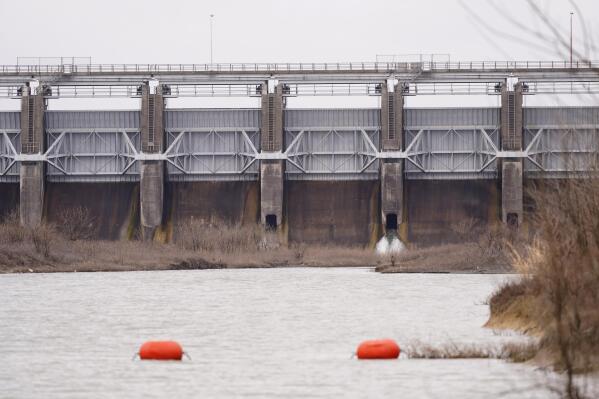
Water flows out of the Rockwall-Forney Dam in Forney, Texas, Wednesday, Feb. 16, 2022. The National Inventory of Dams contains neither the hazard classification nor a condition for the dam, which impounds Lake Ray Hubbard to supply water to more than 1 million people in the Dallas area. A 2021 inspection document provided to the AP by Dallas shows the dam is classified as high hazard and has several issues. (AP Photo/LM Otero)

FILE - Water flows down the Oroville Dam’s crippled spillway in Oroville, Calif., on Feb. 28, 2017. Americans wondering whether a nearby dam could be dangerous can look up the condition and hazard ratings of tens of thousands of dams nationwide using an online database run by the federal government. But they won’t find the condition of Oroville Dam, which underwent a $1 billion makeover after its spillway failed. (AP Photo/Rich Pedroncelli, File)

FILE - Water starts to flow from the lower jet flow gates at Hoover Dam near Boulder City, Nev., Thursday June 11, 1998, during testing of the newly installed jet flow gates. Americans wondering whether a nearby dam could be dangerous can look up the condition and hazard ratings of tens of thousands of dams nationwide using an online database run by the federal government. But they won’t find the condition of Hoover Dam, which impounds one the nation’s largest reservoirs on the border of Nevada and Arizona. (AP Photo/Lennox McLendon, File)

Fencing surrounds lake side of the Rockwall-Forney Dam in Forney, Texas, Wednesday, Feb. 16, 2022. The National Inventory of Dams contains neither the hazard classification nor a condition for the dam, which impounds Lake Ray Hubbard to supply water to more than 1 million people in the Dallas area. A 2021 inspection document provided to the AP by Dallas shows the dam is classified as high hazard and has several issues. (AP Photo/LM Otero)

River water flows from the Rockwall-Forney Dam in Forney, Texas, Wednesday, Feb. 16, 2022. The National Inventory of Dams contains neither the hazard classification nor a condition for the dam, which impounds Lake Ray Hubbard to supply water to more than 1 million people in the Dallas area. A 2021 inspection document provided to the AP by Dallas shows the dam is classified as high hazard and has several issues. (AP Photo/LM Otero)

Signs in Spanish warn of approaching river side of the Rockwall-Forney Dam in Forney, Texas, Wednesday, Feb. 16, 2022. The National Inventory of Dams contains neither the hazard classification nor a condition for the dam, which impounds Lake Ray Hubbard to supply water to more than 1 million people in the Dallas area. A 2021 inspection document provided to the AP by Dallas shows the dam is classified as high hazard and has several issues. (AP Photo/LM Otero)
Water flows out of the Rockwall-Forney Dam in Forney, Texas, Wednesday, Feb. 16, 2022. The National Inventory of Dams contains neither the hazard classification nor a condition for the dam, which impounds Lake Ray Hubbard to supply water to more than 1 million people in the Dallas area. A 2021 inspection document provided to the AP by Dallas shows the dam is classified as high hazard and has several issues. (AP Photo/LM Otero)
Water flows out of the Rockwall-Forney Dam in Forney, Texas, Wednesday, Feb. 16, 2022. The National Inventory of Dams contains neither the hazard classification nor a condition for the dam, which impounds Lake Ray Hubbard to supply water to more than 1 million people in the Dallas area. A 2021 inspection document provided to the AP by Dallas shows the dam is classified as high hazard and has several issues. (AP Photo/LM Otero)
FILE - Water flows down the Oroville Dam’s crippled spillway in Oroville, Calif., on Feb. 28, 2017. Americans wondering whether a nearby dam could be dangerous can look up the condition and hazard ratings of tens of thousands of dams nationwide using an online database run by the federal government. But they won’t find the condition of Oroville Dam, which underwent a $1 billion makeover after its spillway failed. (AP Photo/Rich Pedroncelli, File)
FILE - Water flows down the Oroville Dam’s crippled spillway in Oroville, Calif., on Feb. 28, 2017. Americans wondering whether a nearby dam could be dangerous can look up the condition and hazard ratings of tens of thousands of dams nationwide using an online database run by the federal government. But they won’t find the condition of Oroville Dam, which underwent a $1 billion makeover after its spillway failed. (AP Photo/Rich Pedroncelli, File)
FILE - Water starts to flow from the lower jet flow gates at Hoover Dam near Boulder City, Nev., Thursday June 11, 1998, during testing of the newly installed jet flow gates. Americans wondering whether a nearby dam could be dangerous can look up the condition and hazard ratings of tens of thousands of dams nationwide using an online database run by the federal government. But they won’t find the condition of Hoover Dam, which impounds one the nation’s largest reservoirs on the border of Nevada and Arizona. (AP Photo/Lennox McLendon, File)
FILE - Water starts to flow from the lower jet flow gates at Hoover Dam near Boulder City, Nev., Thursday June 11, 1998, during testing of the newly installed jet flow gates. Americans wondering whether a nearby dam could be dangerous can look up the condition and hazard ratings of tens of thousands of dams nationwide using an online database run by the federal government. But they won’t find the condition of Hoover Dam, which impounds one the nation’s largest reservoirs on the border of Nevada and Arizona. (AP Photo/Lennox McLendon, File)
Fencing surrounds lake side of the Rockwall-Forney Dam in Forney, Texas, Wednesday, Feb. 16, 2022. The National Inventory of Dams contains neither the hazard classification nor a condition for the dam, which impounds Lake Ray Hubbard to supply water to more than 1 million people in the Dallas area. A 2021 inspection document provided to the AP by Dallas shows the dam is classified as high hazard and has several issues. (AP Photo/LM Otero)
Fencing surrounds lake side of the Rockwall-Forney Dam in Forney, Texas, Wednesday, Feb. 16, 2022. The National Inventory of Dams contains neither the hazard classification nor a condition for the dam, which impounds Lake Ray Hubbard to supply water to more than 1 million people in the Dallas area. A 2021 inspection document provided to the AP by Dallas shows the dam is classified as high hazard and has several issues. (AP Photo/LM Otero)
River water flows from the Rockwall-Forney Dam in Forney, Texas, Wednesday, Feb. 16, 2022. The National Inventory of Dams contains neither the hazard classification nor a condition for the dam, which impounds Lake Ray Hubbard to supply water to more than 1 million people in the Dallas area. A 2021 inspection document provided to the AP by Dallas shows the dam is classified as high hazard and has several issues. (AP Photo/LM Otero)
River water flows from the Rockwall-Forney Dam in Forney, Texas, Wednesday, Feb. 16, 2022. The National Inventory of Dams contains neither the hazard classification nor a condition for the dam, which impounds Lake Ray Hubbard to supply water to more than 1 million people in the Dallas area. A 2021 inspection document provided to the AP by Dallas shows the dam is classified as high hazard and has several issues. (AP Photo/LM Otero)
Signs in Spanish warn of approaching river side of the Rockwall-Forney Dam in Forney, Texas, Wednesday, Feb. 16, 2022. The National Inventory of Dams contains neither the hazard classification nor a condition for the dam, which impounds Lake Ray Hubbard to supply water to more than 1 million people in the Dallas area. A 2021 inspection document provided to the AP by Dallas shows the dam is classified as high hazard and has several issues. (AP Photo/LM Otero)
Signs in Spanish warn of approaching river side of the Rockwall-Forney Dam in Forney, Texas, Wednesday, Feb. 16, 2022. The National Inventory of Dams contains neither the hazard classification nor a condition for the dam, which impounds Lake Ray Hubbard to supply water to more than 1 million people in the Dallas area. A 2021 inspection document provided to the AP by Dallas shows the dam is classified as high hazard and has several issues. (AP Photo/LM Otero)


Americans wondering whether a nearby dam could be dangerous can look up the condition and hazard ratings of tens of thousands of dams nationwide using an online database run by the federal government.
But they won’t find the condition of Hoover Dam, which impounds one the nation’s largest reservoirs on the border of Nevada and Arizona. Nor is there any condition listed for California’s Oroville Dam, the country’s tallest, which underwent a $1 billion makeover after its spillway failed.
Details about the conditions of these and other prominent dams are kept secret from the public, listed as “not available” in the National Inventory of Dams.
The lack of publicly available data about potentially hazardous dams has raised concern among some experts.
“These structures impact people, and this is what we’re obviously most worried about. So it is important to share this information,” said Del Shannon, a Colorado-based engineer who has assessed hundreds of dams and is president of the U.S. Society on Dams.
For much of the past couple of decades, the U.S. Army Corps of Engineers declined to reveal the conditions of dams in the National Inventory of Dams — which it maintains — citing security concerns stemming from the Sept. 11, 2001, terror attacks.
But in a move toward greater transparency, the Corps launched an updated website late last year that includes hazard ratings and condition assessments for more than one-quarter of the roughly 92,000 structures.
Yet the status of many dams remains a mystery. That’s because some federal agencies failed to update their data. The Corps also allowed federal agencies and states to restrict the release of information about the dams they oversee, and some continue to do so citing terrorism concerns.
The Associated Press used information obtained by public records requests to states to supplement data in the National Inventory of Dams, tallying over 2,200 high-hazard dams that are in poor or unsatisfactory condition in 48 states and Puerto Rico. But the conditions remain unknown for more than 4,600 high-hazard dams that could cause a loss of life if they fail.
Dam conditions typically are categorized as satisfactory, fair, poor or unsatisfactory.
In the Corps’ database, nearly two-thirds of the 18 federal entities that own or oversee dams provided no condition assessments. That includes the largest federal regulator of dams, the Federal Energy Regulatory Commission, which oversees more than 1,750 dams in 42 states. A FERC spokeswoman said the agency is overhauling its assessment process and intends to have conditions available this summer.
The Corps also declined to include condition assessments for the roughly 740 dams it owns, which include some of the largest in the nation. Instead, the agency posted its own “risk assessments,” ranging from “very low” to “very high.”
Garrison Dam, which constrains the Missouri River in North Dakota to form one of the nation’s largest reservoirs, is described in the database as “safe” but “high risk.” The Corps says the dam’s failure could trigger a cascading failure of downstream dams resulting “in swift, deep, and life-threatening flooding in numerous communities.”
No other entity uses the Corps’ risk-rating system, making it hard to compare the Corps’ dams to others. The Corps said it uses the risk categories to make repairs “in the most effective manner within a constrained budget.”
“The risk assessment information that we’re sharing is actually better information to help people be prepared for a potential issue at a dam,” said Rebecca Ragon, the Corps’ National Inventory of Dams manager.
The AP’s review also found that some federal departments lack consistent policies for releasing dam data. The Bureau of Land Management and the U.S. Fish and Wildlife Service — both part of the U.S. Department of Interior — disclosed hazard and condition details for their dams.
But the department’s Bureau of Reclamation, which oversees 430 dams in the West, denied the AP’s public records request for dam conditions, citing a legal exemption for “information compiled for law enforcement purposes.” The bureau said in an email that disclosing dam conditions “would compromise the protection of our facilities and allow targeted attacks of critical infrastructure.”
Data from some states is also limited or missing.
Alabama has no agency to regulate dams, so there are no condition or hazard ratings for its roughly 2,200 dams.
Illinois doesn’t assign condition ratings, because lumping dams into categories “is terribly subjective” and doesn’t “have enough value to justify the resources that it takes to do it,” said state dam safety engineer Paul Mauer Jr. However, the state works with dam owners to make needed repairs.
New Jersey and Texas provided AP a total number of poor or unsatisfactory high-hazard dams but did not identify them by name. New Jersey has not released dam conditions but plans to do so by the end of May under a recent policy change. Texas declined to release hazard classifications, citing a state law that keeps confidential the “technical details” of critical infrastructure that’s vulnerable to terrorism.
The National Inventory of Dams contains neither the hazard classification nor a condition for the Rockwall-Forney Dam, which impounds Lake Ray Hubbard to supply water to more than 1 million people in the Dallas area.
A 2021 inspection document provided to the AP by Dallas shows the dam is classified as high hazard and has several issues, including a fractured floodgate and a large void in the rocks lining the left side. A more in-depth inspection report isn’t complete.
Though an overall condition assessment is not available, “none of these things are of immediate concern,” said Sally U. Mills-Wright, assistant director for water production at Dallas Water Utilities.
Without access to information, it’s hard for the public to verify that.
Because dam failures carry big consequences, the public should be made aware of a dam’s hazard rating and what lies in its downstream flood zone, said Travis Attanasio, a former dam inspector who is president-elect of the Texas section of the American Society of Civil Engineers.
“You may not necessarily be in flood plain, but if a dam were to break, you could still be facing a lot of water,” he said.

