The trump shooting

ANATOMY OF A Security failurE

Donald Trump surrounded by Secret Service agents with his fist in the air and blood on his ear and face
A tale of crushing security lapses, missed chances

By Colleen Long and Calvin Woodward

Photos by Evan Vucci and Gene J. Puskar

Updated SEPTEMBER 25, 2024

The acting director of the Secret Service was incensed at what had happened that July evening. “What I saw made me ashamed,” Ronald Rowe Jr. said. “I cannot defend why that roof was not better secured.”

The unguarded roof, easily within shooting distance of the rally stage, is just one of the myriad questions behind the worst Secret Service security failure in decades. The more that investigators unpack from that day, the more missed opportunities that could have prevented the attack are revealed.

As the United States grapples with an second assassination attempt on Donald Trump’s life, in Florida, there remains a reckoning to be done from the Pennsylvania shooting on July 13 that killed one man and wounded three — the ex-president among them.

The Secret Service is a well-funded, historically elite force with a mission to keep presidents and other higher-ups safe — whether they're out for a bicycle ride, attending a world summit, visiting a war zone or campaigning.

But at the farm show grounds, a young nursing home aide with a rifle he borrowed from his dad outmaneuvered authorities for more than 90 minutes before firing the shots that came millimeters from killing Trump.

More than two months later, everyone still wants to know:

• When rallygoers reported a man skittering on the squat rooftop of a nearby building, why didn’t anyone in law enforcement move faster?

• Why did the Secret Service exclude that building from its security perimeter, leaving it to local police, and why did the local force not station someone on the roof?

• Why could local law enforcement agencies not communicate in real time with Secret Service agents when they’re supposed to be working together?

• Why did the Secret Service decline offers by local police to use their surveillance drone at the site? And why did Secret Service agents not deploy a system that would have told them an unauthorized drone was aloft — the gunman's — until it was too late?

One overarching question may never be answered. And in these poisonous times, with the November presidential election closing in and a second attempt on Trump’s life just days in the past, it is urgent: What possessed 20-year-old Thomas Matthew Crooks to try to kill the former president? The public is no closer to that answer than in the immediate aftermath.

2 cars parked in the driveway of a house with police tape in front.
The home of Matthew Crooks, the 20-year-old who tried to kill Donald Trump. (AP Photo/Gene J. Puskar)

This anatomy of an attempted assassination is based on an AP review of dozens of documents, text messages and video, a congressional report and a Secret Service report on the failures, plus interviews on the record and from law enforcement officials who spoke to AP on condition of anonymity to discuss investigations that are still getting going.

The Secret Service faces a reckoning

Rowe sat there under the bright lights, his mouth pressed into a thin line, his voice thick with anger, as senators laid into him and his agents — questioning how on Earth some guy was able to get on top of a nearby roof as the rally was going on and fire off eight rounds, grazing Trump’s ear and ripping into three other people, killing one of them.

Rowe’s voice grew louder at the July 30 Senate hearing as he squared off with lawmakers who wanted him to fire somebody — anybody — who had been on the ground that day. It wasn’t enough for them that the agency's chief, Kim Cheatle, had resigned a week earlier. But Rowe dug in.

“I will not rush to judgment," he said, snapping at a senator. “People will be held accountable, and I will do so with integrity.”

Secret service shielding Donald Trump on the floor.
Trump is covered by U.S. Secret Service agents at a campaign rally, Saturday, July 13, 2024, in Butler, Pa. (AP Photo/Evan Vucci)

He wasn’t blaming anyone in particular, though he did throw some not-so-subtle shade at the Pennsylvania police officers who were supposed to be guarding the building complex in question.

But he also wasn’t trying to play down his agency's epic failure as it became slowly clearer to local officers that Crooks wasn’t just an oddball with a backpack. Local police did finger-pointing of their own, citing communications breakdowns that began when the face-to-face meeting the Secret Service said would happen with them before the event never did.

Secret Service agents in the line of duty have been equipped since the 1940s with various gadgets enabling them to communicate remotely in real time. Back when everyday people had to find a phone booth, these agents could be seen wearing wired earbuds or talking up their sleeves.

Secret Service shielding Donald Trump who has blood on his ear and face
Trump is helped off the stage at a campaign event in Butler, Pa., on Saturday, July 13, 2024. (AP Photo/Gene J. Puskar)

Yet when a man outside the perimeter of metal detectors and Secret Service scrutiny raised suspicions, then fears, then his rifle on the roof, the agency's local police backups could not get word directly to the agents closest to Trump or the federal snipers on other rooftops in time to hustle him off the stage or take down the gunman.

Last week, the Secret Service released a five-page document summarizing conclusions in a report not yet completed. Among the findings: The Secret Service did not give clear guidance to local law enforcement partners at the rally. It did not correct line-of-sight problems that left Trump open to sniper fire. And some of the agents on duty that day were complacent.

A bipartisan report from the Senate Homeland Security and Governmental Affairs Committee made public Wednesday was more blunt if not scathing. It found “USSS failures in planning, communications, security, and allocation of resources for the July 13, 2024, Butler rally were foreseeable, preventable and directly related to the events resulting in the assassination attempt that day.”

Before the shooting, everything felt typical

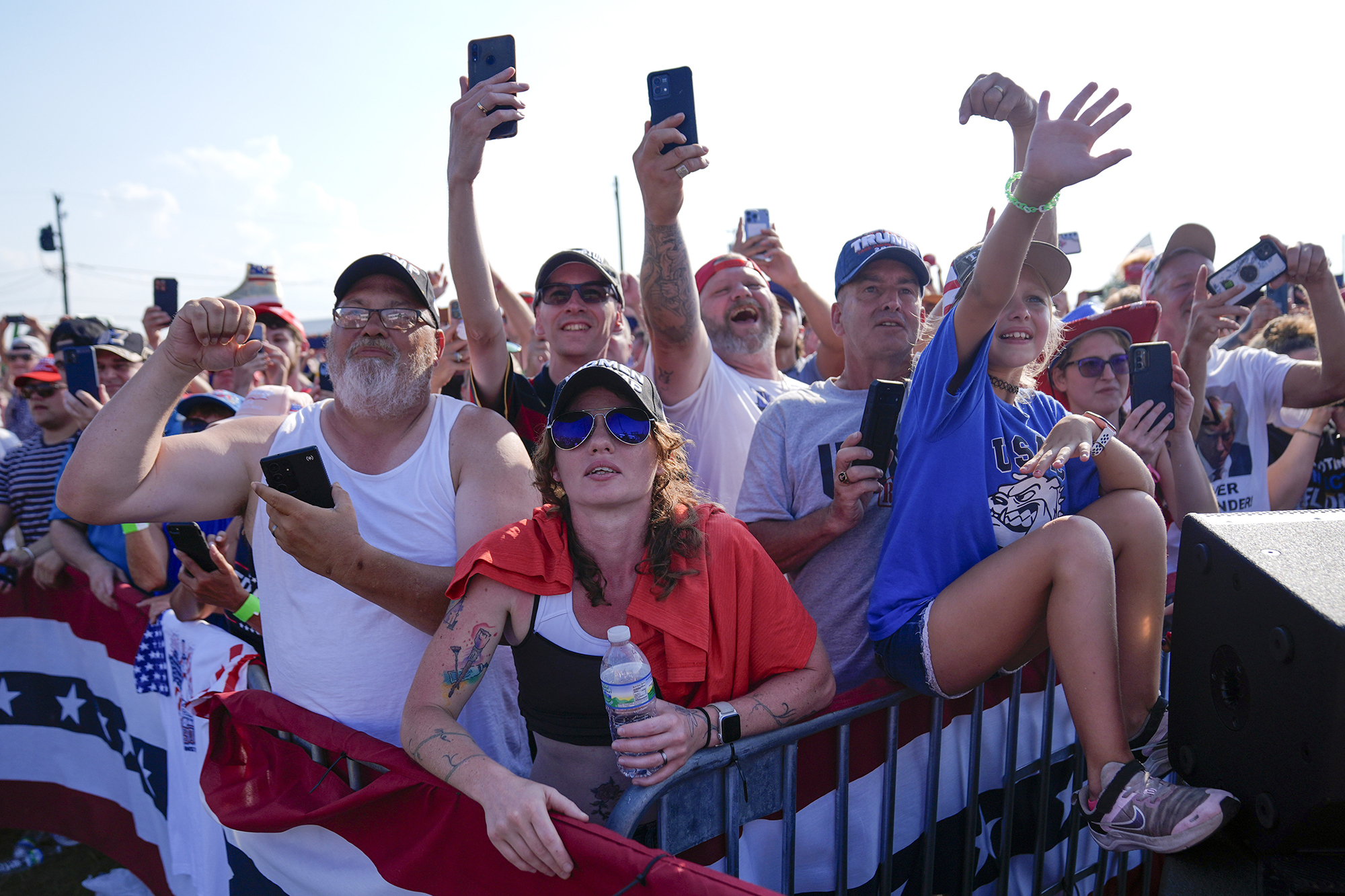
It was designed to be a typical Trump rally — outdoors at the Butler Farm Show grounds with big red barns, wide-open fields and bleacher seating.

Crowd cheering at a rally
Supporters cheer as Trump arrives for a campaign rally. (AP Photo/Evan Vucci, File)

Butler County, on the western edge of a presidential swing state, is a Trump stronghold. In a place where turnout hovers around an impressive 80%, Trump won with about 66% of the vote in both 2016 and 2020. The rural area north of Pittsburgh has notoriously bad cell service, which made police communications even worse in the crisis to come. The Secret Service did not bring a system to boost device signals in such places.

Three days after the rally was announced, Crooks registered to attend. He also searched online for “how far away was Oswald from Kennedy?”

Lee Harvey Oswald shot and killed President John F. Kennedy in Dallas on Nov. 22, 1963, while he was riding in an open convertible. Oswald concealed himself on the sixth floor of the Texas School Book Depository. The Warren Commission determined he was 265.3 feet from Kennedy when he fired the fatal shot.

Crooks would fire from about double that distance. But guns have evolved since then, and the AR-style weapon Crooks borrowed from his father shoots faster and more easily than anything Oswald had on him.

A backpack and broken down rifle.
This image provided by the FBI shows Thomas Matthew Crooks' rifle broken down as was likely done for transport and the backpack recovered at the scene in Butler, Pa. (FBI via AP)

On July 7, Crooks made the trip from his Bethel Park home, just south of Pittsburgh, to the Butler Farm Show grounds, and was there for about 20 minutes. FBI investigators say he was casing the area. The day before the rally, he practiced shooting at a local sports club.

On July 13, he returned to the grounds and stayed for about 70 minutes before going home. At 1:30 p.m., his dad gave him the rifle, thinking his son was headed back to the club to practice shooting. Twenty-five minutes later Crooks was buying 50 rounds of ammunition.

He parked at a gas station lot about a third of a mile from the rally, dressed in camo shorts, a black belt and a gray T-shirt with the logo of a YouTube channel dedicated to firearms. He rode a bicycle to the grounds and carried a big backpack.

Agents have cracked into his phone, searched his laptop and interviewed hundreds of people. Yet the FBI says his motive remains unknown.

Crooks was described by classmates at Bethel Park High School as smart but standoffish, often seen wearing headphones and sitting alone at lunch looking at his phone. Some said he was often mocked by other students for the clothes he wore, which included hunting outfits, and for wearing a mask even after the COVID-19 pandemic had subsided.

“He sat by himself, didn’t talk to anyone, didn’t even try to make conversation,” said 17-year-old Liam Campbell, echoing the comments of classmates who remembered the shooter. “He was an odd kid,” but nothing about him seemed dangerous, he added. “Just a normal person who seemed like he didn’t like talking to people."

After graduating high school in 2022, Crooks went on to the Community College of Allegheny County, earning an associate’s degree with honors in engineering science this past May. He also worked at a nursing home as a dietary aide.

Crooks had been registered as a Republican voter, according to state records. But there was also a $15 donation to a progressive group recorded under “Thomas Crooks” in January 2021.

Authorities received many reports beforehand

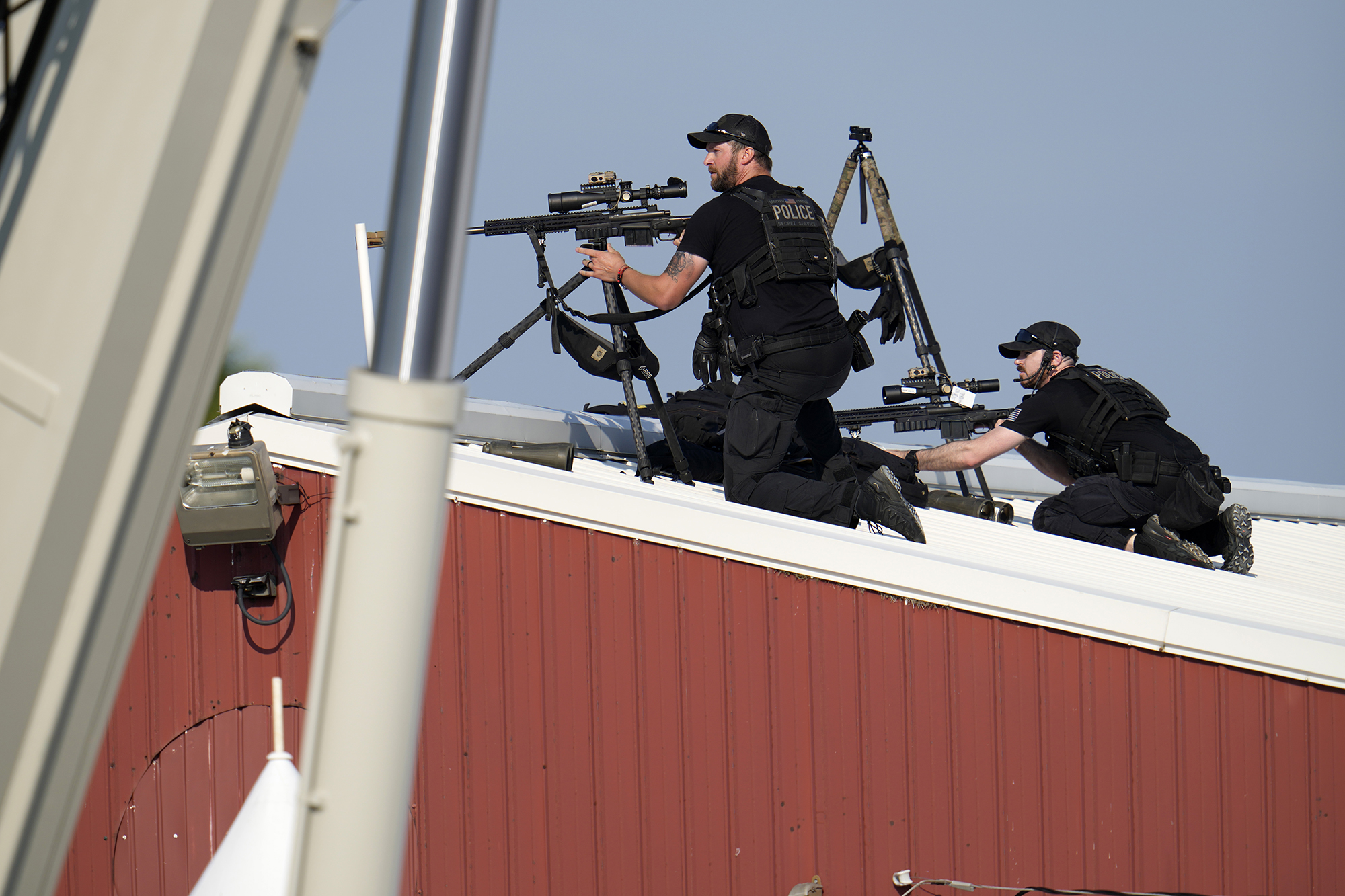
There were roughly 155 law enforcement officers at the rally that day. That included a Secret Service counter-sniper team, a Butler County SWAT team and uniformed officers. Hundreds of Trump supporters gathered to hear him speak.

2 snipers on a roof
Police snipers return fire after shots were fired while Trump was speaking at a campaign event in Butler, Pa. (AP Photo/Gene J. Puskar)

The FBI says that after Crooks turned up at the site on that sunny Saturday afternoon, he flew a drone for about 11 minutes up and around the area and was getting the view directly on the controller he used. The Secret Service did not deploy its drone-detection system until later in the afternoon. And the advance team that scouts the venue ahead of time requested additional technology before the rally, but those requests were denied.

The first reported sighting of Crooks was at 4:26 p.m., more than 1½ hours before Trump would begin speaking. A Beaver County sniper team member noticed Crooks at a picnic table, thought he was acting suspiciously, and alerted other local snipers who were posted inside the AGR building complex. “He knows you guys are up there,” the sniper texted the others. “He’s sitting to the direct right on a picnic table about 50 yards from the exit.”

At 5:38 p.m., a Beaver County sniper, stationed inside the building where Crooks would later shoot from the roof, sent photos of Crooks to the local team’s group chat. "I did see him with a rangefinder looking towards the stage. If you wanna notify SS snipers to look out. I lost sight of him.” He also said there was a bike with a backpack nearby that wasn’t seen earlier.

Secret Service sniper teams were posted on the roof closest to where Trump was to speak, but officials say the teams were never notified.

At 5:45 p.m., a local sniper recommended that the command post, where team leaders were stationed, be alerted about Crooks. There were two posts; the Secret Service agents were only in one.

“They’re asking for a direction of travel,” one local sniper says.

“Not sure,” Beaver County SWAT sniper Gregory Nicol responded in a message at 6 p.m., about 11 minutes before Crooks would fire. “He was up against the building. If I had to guess toward the back. Away from the event.”

“I assumed that there would be somebody coming out to — you know, to speak with this individual or, you know, find out what’s going on,” Nicol later told ABC News.

The AGR (American Glass Research) complex is a warren of buildings, and Crooks eventually got to the roof of the building closest to the rally site. Nicol was trying to shadow Crooks from within the buildings but lost sight of him.

Footage shows Crooks walking back to his car, parked near where the other local snipers were parked. There were improvised explosive devices inside the car, but no one knew.

Bystanders saw Crooks again shortly after. They took mobile phone video of him pulling himself up to the top of the roof and slithering into position. They called the cops. These rally-goers were on alert for what the authorities either hadn't noticed or hadn't treated with the urgency that might have made a difference. You could say security in this moment was crowdsourced.

Credit: DJ Laughery

By 6:08 p.m., law enforcement had eyes on Crooks again. A Secret Service countersniper saw law local officers running toward the building with their guns drawn, but he didn't think to alert Trump's protective detail to pull the GOP candidate from the stage.

Three minutes later, a local officer was hoisted up the squat roof by another officer, who saw Crooks with the rifle, laying down and pointing the weapon toward him. “He’s armed,” the officer radioed to his squad. “He’s got a long gun.”

That message did not make it to key Secret Service officials. The shots were fired 30 seconds later.

Video/Pool
investigators struggle and Trump leverages

Days after the shooting, Trump spent more than 10 minutes of his speech to the Republican National Convention giving vivid detail of what happened to him on the “warm, beautiful day in the early evening in Butler Township in the great Commonwealth of Pennsylvania.”

The crowd was rapt. Some in it would later don ear bandages like his in a show of support. Even some of Trump's fiercest critics conceded his turn on the stage in Butler had been masterful — raising his fist as blood trickled down his face, mouthing “fight” as he was hustled away.

Donald Trump on stage with a digital billboard behind him.
Trump arrives for a campaign rally, July 13, 2024, in Butler, Pa. (AP Photo/Evan Vucci)
Donald Trump giving a speech at a podium with a chart behind him.
Trump speaks at a campaign rally, July 13, 2024, in Butler, Pa. (AP Photo/Evan Vucci)
Secret service shielding Donald Trump on the ground.
U.S. Secret Service agents converge to cover Trump at a campaign rally, July 13, 2024, in Butler, Pa. (AP Photo/Evan Vucci)
A sniper
Trump is covered by U.S. Secret Service agents at a campaign rally, July 13, 2024, in Butler, Pa. (AP Photo/Evan Vucci)
A crowd of people hiding behind bleachers and laying on the floor
People react during a campaign rally with Trump at a campaign rally, July 13, 2024, in Butler, Pa. (AP Photo/Evan Vucci)
Secret Service and a sniper
U.S. Secret Service agents respond as Trump is surrounded on stage by U.S. Secret Service agents at a campaign rally, July 13, 2024, in Butler, Pa. (AP Photo/Evan Vucci)
Donald Trump with blood on his face raising his fist.
Trump reacts following an assassination attempt at a campaign event in Butler, Pa., July 13, 2024. (AP Photo/Gene J. Puskar)

Trump told his convention “the assassin’s bullet came within a quarter of an inch of taking my life.” It was not an exaggeration, or at least not much of one.

Those who tuned in at the start of his speech saw a man trying, for once, to reach a wider audience than his MAGA millions. “The discord and division in our society must be healed,” Trump said. “We must heal it quickly.”

That didn't last long. Most of the rest of his speech returned to standard operating procedure — the bombast, the falsehoods, the depictions of a United States rotting under Democrats.

The temperature has not cooled since. After the episode at the golf course, Trump and his allies now are trying to lay blame directly on Democratic rhetoric for making him a literal target.

In that case, officials said, the suspect did not get off any shots, never had Trump in his line of sight and fled from the scene after a Secret Service agent spotted and fired at him. He was later captured.

By those measures, it was a more successful security operation than in Butler. Yet the Secret Service, once again, has much to answer for. The man was able to lurk on the perimeter of Trump's property for nearly 12 hours, police said, evading detection as he lay in wait with a rifle, scope, video camera and food.

Investigators have done more than 1,000 interviews on the Butler shooting. They’ve fielded more than 2,000 tips. In addition to getting into Crooks' phone, they've searched his home and sent the explosive devices found in his car to a lab for testing.

Yet deputy FBI Director Paul Abbate says authorities have had to grapple with a “general absence of other information to date." That means no motive has been identified, no co-conspirators found. The Secret Service shot and killed the gunman on the scene.

Crooks’ behavior didn’t rise to the level of alarm at first. Secret Service officers only were told about a suspicious person the local authorities were worried about. The countersniper who saw the officers running with guns drawn never made the connection to pull Trump from the stage. In such moments, officers are listening for escalatory words like “threat” or “gun.”

Such words came later, in the final seconds, but the message didn't land. There was no one radio frequency all the multi-agency officers could hop on. Instead, local officers had to radio the joint command center, where the Secret Service would relay messages to Trump's detail.

Jason Woods, team leader for Beaver County’s Emergency Services Unit and SWAT sniper section, told ABC News his people had no contact with the agents on Trump’s security detail. “We were supposed to get a face-to-face briefing with the Secret Service members whenever they arrived, and that never happened,” Woods said. “So I think that was probably a pivotal point, where I started thinking things were wrong because it never happened. We had no communication — not until after the shooting.”

The Senate committee report is only preliminary and promises more details. But it plainly states the massive Secret Service failures.

U.S. Secret Service Acting Director Ronald Rowe headshot
U.S. Secret Service Acting Director Ronald Rowe, testifies before a Joint Senate Committee. (AP Photo/Kevin Wolf)

Congressional inquiries are bound to escalate in the hothouse of the presidential campaign and as law enforcement learns more. At the first one, Rowe, the acting Secret Service chief, implied that the local officers might bear some responsibility for the failure, too.

“Controlling high ground is something that’s a must for us whenever we go into a location,” Rowe said. “We made an assumption” that local teams were covering the AGR building.

“If they had just held their post and looked left," Rowe said, his voice trailing off. “Maybe.”

He didn't press the point much. Later, he told a news conference: “This was a Secret Service failure.”

(AP Video/Gene J. Puskar)

Security at the July 13 Trump rally in Pennsylvania was a tragedy of errors.

Here is some of what went wrong for the Secret Service and local police on the grounds of the Butler Farm Show before a man fired eight shots from a nearby roof in an attempt to kill Trump. The attack left one man dead, two people seriously wounded and Trump nursing a wound to his ear.

Fateful assumptions

Local officers said they were promised a Secret Service briefing before the event but didn't get one. They also expected “constant communication” with the agency but one local official said there was no direct contact until after the shooting. For his part, the acting Secret Service director, Rowe, said controlling the high ground is "a must for us" and the agency wrongly “made an assumption” that local snipers were doing so at the AGR building.

Drone detection

Shortly before 4 p.m. on July 13, Crooks flew his drone over the rally grounds for 11 minutes, covering 200 yards or 180 meters, the FBI said. Crooks livestreamed the flight. The Secret Service can detect unauthorized drone flights and even pinpoint people controlling them but could not get its system for doing so operational until about an hour later. Had the detection system been activated earlier, Crooks might well have been intercepted and interrogated.

Drone surveillance

The Secret Service declined an offer from local police to use their surveillance drone for the event. “We probably should have taken them up on it,” the agency's acting chief, Rowe, told a congressional hearing.

That roof

“That roofline should have been covered,” Rowe, the acting Secret Service chief, told lawmakers. Everyone agrees in hindsight. The question is why local sniper teams were posted inside the building, not on top of it. The squat roof was easy to access for Crooks. In 1963, Lee Harvey Oswald shot and killed President John Kennedy in Dallas from the sixth floor of the Texas School Book Depository, 265 feet (81 meters) away. Crooks fired from about double that distance, easily within shooting range for today's AR-style rifles.

30 seconds

Trump took the stage at 6:05 p.m. Three minutes later, local officers saw Crooks on the roof. Three minutes after that, a local officer rose above the roofline and saw Crooks with the rifle, which the gunman turned toward him. The retreating officer radioed his team that the man had a “long gun” and the team radioed the joint command center to get urgent word to Secret Service agents closest to Trump. This was at 6:11 p.m. “None of that information ever made it over our net,” acting Secret Service director Rowe testified to Congress.

Communication snarls

The Secret Service did not bring technology, such as mobile satellite units, to boost signals in an area with bad cell phone service. The Secret Service and local police also were on different radio frequencies — an enduring problem among intergovernmental authorities in this country — so local units had to contact a command center, where urgent messages could then be relayed to Trump's security detail. And in a bad signal environment, the most urgent message of all that day — that a man on a roof had a gun — was not received. The Secret Service agents closest to Trump heard nothing about a man with a gun until the bullets flew.

What's a suspicious person?

Local police noticed a number of people who looked or acted suspicious that day. That’s typical. Many who draw police attention are up to no harm. The local team first reported to higher-ups concern about Crooks at 4:16 p.m.., took his picture almost an hour later and, as their concern grew, notified someone with the Secret Service about a suspicious person. This was 25 minutes before the shooting. Words that escalate concern, like “threat" or “gun,” were apparently not said until just before he opened fire.

How it works

The Secret Service is in charge of securing events for those it protects but always partners with local law enforcement when a president, candidate or other high-level official comes to town. Local forces are not paid to back up the agents, and doing so often requires overtime pay and strains budgets. As is typical, the federal agency sent an advance team to scope out the scene and identify any areas of concern. Starting five days before the rally, the team set up barriers, blocked roads and ordered vehicles moved. They are supposed to be in constant coordination, but along the way little communication lapses added up to a big failure.

show CREDITS